📚 Part of our Heart Health Guide — an evidence-based guide.
Medically referenced. This article reports on a systematic review and dose-response meta-analysis published in The Lancet Public Health. It is not medical advice.
The “10,000 steps a day” target is one of the most repeated health rules in the world — and one of the least scientific in origin. It didn’t come from a study. It came from a 1960s Japanese pedometer marketing campaign. So when researchers finally put daily step counts under rigorous analysis, the real number turned out to be lower, more achievable, and far more encouraging than the myth.
What the Big Analysis Found
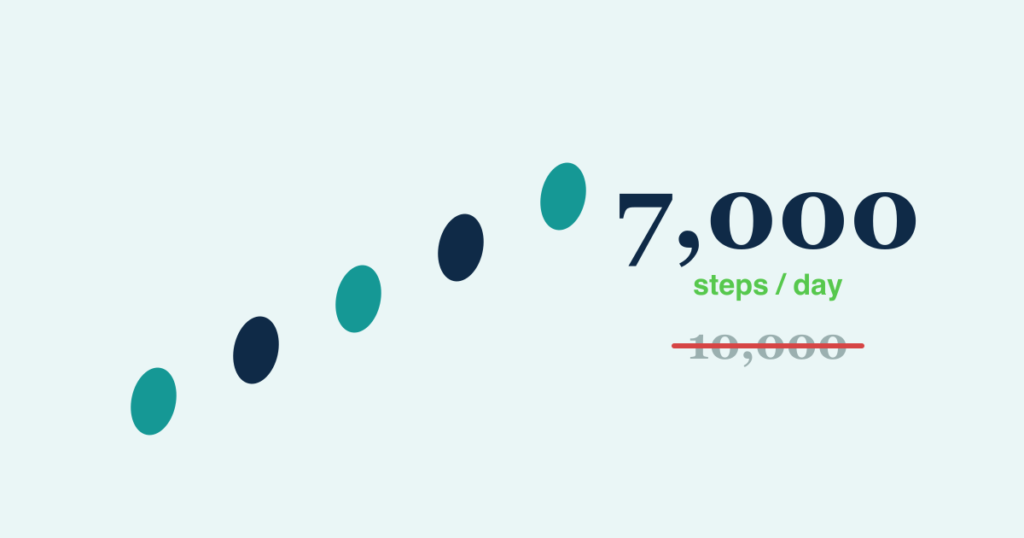
A systematic review and dose-response meta-analysis published in The Lancet Public Health, pulling together 31 studies, found that walking about 7,000 steps a day was associated with dramatically lower risk across the board — including a roughly 47% lower risk of all-cause mortality compared with about 2,000 steps a day.[1]
And here’s the part that should take the pressure off: going from 7,000 to 10,000 steps added relatively little. At 10,000 steps, the all-cause mortality benefit was about 48% — barely different from 7,000.[1] In other words, most of the payoff arrives well before the famous 10,000 mark. The reviewers concluded that 7,000 steps is a realistic, achievable target that captures the bulk of the benefit.[1]
The Steepest Gains Are at the Bottom
The most important message in this data is for people who move the least. The curve is steepest at the low end — meaning the jump from a sedentary 2,000–3,000 steps to 5,000–6,000 delivers a larger relative benefit than any increase after that. If you’re not very active, you don’t need to hit a huge number to gain a lot. You need to move more than you do now.
It Depends a Little on Your Age
The research found the “enough” point shifts slightly with age: for adults over 60, the mortality risk kept dropping until about 6,000–8,000 steps a day, while for those under 60 it continued to about 8,000–10,000.[1] Younger people may squeeze a bit more from higher counts; older adults reach the plateau sooner.
Why Walking Does So Much
Steps are really a proxy for something deeper: regular, low-intensity movement throughout the day. As we’ve covered, working muscle pulls glucose from your blood, movement lowers blood pressure and resting heart rate, and breaking up sitting improves how your body handles sugar. Walking quietly touches nearly every system this site covers — which is why it keeps showing up in the research as one of the highest-value, lowest-cost health habits available.
How to Use This
- Forget 10,000 as a rule. Aim for 7,000 as a strong, evidence-based target — and know that even hitting it most days matters more than any single day.
- If you’re sedentary, start by adding 2,000. The biggest gains come from the first increases, not the last.
- Stack steps onto existing routines — a post-meal walk (which also blunts blood sugar, as we covered here), a walking phone call, parking farther away.
- Track the trend, not the perfection. A wearable helps, but consistency beats any single big day.
The freeing truth here is that the bar is lower than you were told. You don’t need 10,000 steps or a gym membership to meaningfully change your health odds. You need to move a bit more, most days — and that’s a target almost anyone can reach.
This article is for informational purposes only and is not a substitute for professional medical advice. Always consult a qualified healthcare provider before starting a new activity program, especially if you have a heart or joint condition.
References
- “Daily steps and health outcomes in adults: a systematic review and dose-response meta-analysis.” The Lancet Public Health. thelancet.com
Frequently asked questions
Do you really need 10,000 steps a day?
No. The 10,000 figure came from marketing, not science. Research links meaningful drops in mortality to far fewer steps, with benefits leveling off well before 10,000.
How many steps a day are enough?
Studies suggest major health benefits begin around 6,000-8,000 steps a day for many adults, with older adults benefiting from even fewer.
Does walking speed matter?
Yes. A brisker pace appears to add benefit beyond step count alone, though simply moving more is the foundation.