📊 Original analysis. We analysed the CDC’s NHANES 2021–2023 files ourselves, combining measured A1C with what participants said they had been told. Full method and limitations below; figures are free to cite with attribution.
Prediabetes is the rare diagnosis that is genuinely good news to receive, because it is the stage at which the outcome can still be changed. Which makes the size of the gap between who has it and who knows about it the most consequential number in the whole condition.
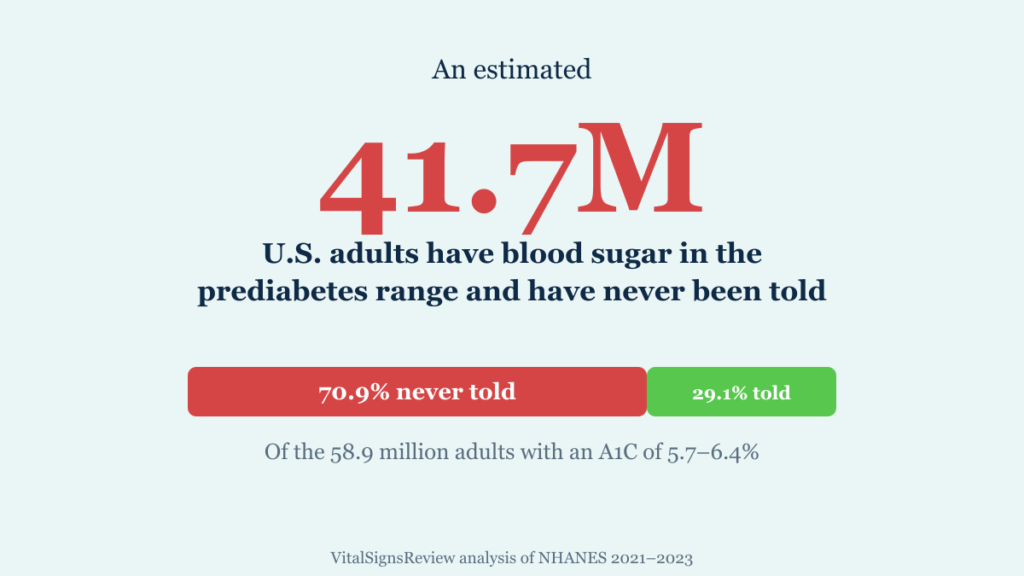
We measured that gap. Among U.S. adults with blood sugar in the prediabetes range, 70.9% had never been told — about 41.7 million people.
What we found
Of adults aged 20 and over, 24.3% (95% CI 22.2–26.5) had an A1C between 5.7% and 6.4%, the prediabetes range. That represents roughly 58.9 million people.
Among that group, only 29.1% (CI 26.1–32.2) reported ever having been told by a health professional that they had prediabetes or borderline diabetes. The remaining 70.9% — approximately 41.7 million adults — had blood sugar in the range and no idea.
Awareness was low in every age group, and it never rose above one in three.
Share who have ever been told they have prediabetes, by age
Among adults with an A1C of 5.7–6.4%. Even in the oldest group, fewer than one in three had been told.
The youngest group was least likely to know, which matters because they have the most to gain: the earlier prediabetes is interrupted, the better the odds of returning glucose to normal. Women were somewhat more likely than men to have been told (32.7%, CI 28.7–36.7, versus 25.5%, CI 22.6–28.3), plausibly reflecting more frequent contact with healthcare.
Screening gap or communication gap?
This is the question the raw prevalence number cannot answer, and NHANES lets us split it. Participants were also asked whether they had had a blood test for high blood sugar in the previous three years.
Why they were never told
Among the 41.7 million unaware adults. The remaining ~64% report no recent test at all — a screening gap rather than a communication one.
Among the 41.7 million unaware adults, only 35.8% (CI 32.3–39.2) reported a blood sugar test in the past three years. Roughly two thirds had not been tested at all.
So the larger problem is screening, not communication. Most of these people were never measured. But the smaller share is arguably more troubling: for more than a third, a test happened and the information still did not reach them — or reached them in a form they did not retain. Both are fixable, and they need different fixes.
One honest caveat on that split: a test three years ago could have been genuinely normal at the time, with the A1C drifting upward since. Cross-sectional data cannot separate that from a missed result.
Diabetes is caught far more reliably
The contrast with full diabetes is stark, and it is instructive.
Diabetes, by contrast, is caught far more often
Undiagnosed diabetes is 5.5 million adults; unrecognised prediabetes is 41.7 million.
Using the standard definition — either a reported diagnosis or an A1C of 6.5% or above — total diabetes prevalence came out at 14.0% of adults (CI 12.6–15.5). Of those cases, 16.2% were undiagnosed, representing about 5.5 million adults.
Undiagnosed diabetes is a serious problem affecting 5.5 million people. Unrecognised prediabetes affects 41.7 million — roughly eight times as many. The system is far better at catching the disease than the warning that precedes it, which is precisely backwards from where the leverage sits.
How our numbers compare with the CDC’s
Two comparisons are worth making explicitly, because a reader who knows the published figures might otherwise think we contradict them.
Diabetes. Our 14.0% for adults closely matches the CDC’s own reported figure of roughly 14–15% of U.S. adults with diagnosed or undiagnosed diabetes. This is our main check that the survey weighting is behaving correctly.
Prediabetes. The CDC reports that around 38% of U.S. adults have prediabetes. Our 24.3% is lower, and the reason is definitional rather than contradictory: the CDC uses A1C or fasting glucose, while we used A1C alone. A1C-only is a narrower net, so our figures are conservative. Had we added fasting glucose, both the prevalence and the unaware count would have been higher, not lower. Treat 41.7 million as a floor.
What this means
It means the single most useful thing most adults can do about prediabetes is find out whether they have it. A fasting glucose and an A1C are routine, inexpensive, and the majority of the people who most need them have not had them.
It matters because prediabetes responds to ordinary changes better than almost anything in medicine. In the landmark Diabetes Prevention Program, modest weight loss plus regular activity cut progression to type 2 diabetes dramatically — outperforming medication. The evidence is summarised in can you reverse prediabetes, and the practical protocol in how to lower blood sugar naturally.
None of that helps someone who does not know. That is what 41.7 million describes.
What to ask for
Ask for a fasting glucose and an A1C if you have never had them, if you are 45 or older, or at any age if you carry excess weight around the middle, have a family history of type 2 diabetes, had gestational diabetes, have high blood pressure, or have polycystic ovary syndrome.
If you have had a test, ask for the actual numbers rather than “normal.” A fasting glucose of 99 and one of 101 sit on opposite sides of a threshold while being biologically identical, and a value drifting upward within the normal range is information you cannot get from the word “fine.” What each number means is in what is a normal blood sugar level, and our A1C converter translates a result into estimated average glucose.
Method
Data. NHANES 2021–2023 public-release files from the CDC: demographics (DEMO_L), glycohemoglobin (GHB_L) and the diabetes questionnaire (DIQ_L).
Sample. Adults aged 20 and over with a valid measured A1C and a positive phlebotomy subsample weight, excluding participants recorded as pregnant. Analytic n = 5,730, representing approximately 242.0 million adults. The prediabetes-range subgroup was n = 1,574.
Definitions. Prediabetes range: A1C 5.7–6.4%. Diabetes range: A1C 6.5% or above. Total diabetes: a reported diagnosis (DIQ010) or A1C of 6.5% or above. “Ever told” prediabetes counts participants answering yes to having been told they had prediabetes (DIQ160) or reporting borderline diabetes (DIQ010) — the more generous reading, which makes our unaware estimate conservative. Recent testing is self-reported blood sugar testing in the previous three years (DIQ180).
Estimation. Prevalences are weighted with the two-year phlebotomy subsample weight (WTPH2YR), which is the appropriate weight for A1C. Standard errors account for the complex survey design — stratification (SDMVSTRA) and primary sampling units (SDMVPSU) — via Taylor-series linearisation for a ratio estimator. Intervals are 95%.
Limitations
A1C alone is a narrower definition than the ADA criteria, which also permit fasting glucose or an oral glucose tolerance test. Our prevalence and unaware counts are therefore lower bounds.
Awareness is self-reported. Someone may have been told and not remembered, or not understood the term used. This cuts in the direction of overstating unawareness.
Cross-sectional. A single snapshot. It cannot show whether a person’s A1C was already elevated when they were last tested.
The 2021–2023 cycle is unusual. NHANES collection was disrupted around the COVID-19 pandemic and the CDC advises caution in comparing it with earlier cycles. We made no historical comparisons for that reason.
Crude, not age-standardised. Figures describe the population as it is, which is the right choice for counting people but makes them unsuitable for comparison across populations with different age structures.
Not peer reviewed. This is our own analysis of public data, published with its method stated so anyone can check or contradict it.
Citing this
VitalSignsReview analysis of NHANES 2021–2023. “70.9% of U.S. adults with prediabetes-range A1C have never been told — about 41.7 million people.” Available at https://vitalsignsreview.com/nhanes-undiagnosed-prediabetes/
Journalists and researchers are welcome to use these figures with attribution. If you want the analysis script or an additional breakdown — by state is not possible in NHANES, but by age, sex, ethnicity, weight status or insurance is — ask through our contact page and we will run it.
The honest bottom line
Roughly 58.9 million American adults have an A1C in the prediabetes range, and about 41.7 million of them have never been told. Two thirds were never tested; for the remaining third the information existed and did not land. Our figures are conservative because we used A1C alone, and the true numbers are higher. The condition at the centre of this is the one that responds best to ordinary change — which makes a gap this size less a medical problem than a plumbing one.
The test behind these figures has real limitations worth knowing: how A1C works and when it misleads.
Frequently asked questions
How many Americans have prediabetes and don't know it?
In our analysis of NHANES 2021-2023, about 41.7 million US adults had an A1C in the prediabetes range (5.7-6.4%) and had never been told. That is 70.9% of everyone in that range. Because we used A1C alone rather than A1C or fasting glucose, the real figure is higher.
What A1C level is prediabetes?
An A1C of 5.7% to 6.4% is the prediabetes range. Below 5.7% is normal and 6.5% or above indicates diabetes, each confirmed on a second test.
Why don't people know they have prediabetes?
Mostly because they were never tested: among unaware adults in our analysis, only 35.8% had a blood sugar test in the previous three years. Prediabetes also produces no symptoms, so nothing prompts them to ask.