📚 Part of our Blood Sugar Guide — an evidence-based guide.
Imagine a single muscle you could switch on while sitting perfectly still at your desk — no gym, no sweat, no standing up — that quietly soaks up sugar from your bloodstream for hours. It sounds like a gimmick. It isn’t. It’s one of the more surprising findings in recent metabolic science, and it centers on a muscle most people never think about: the soleus, deep in your calf.
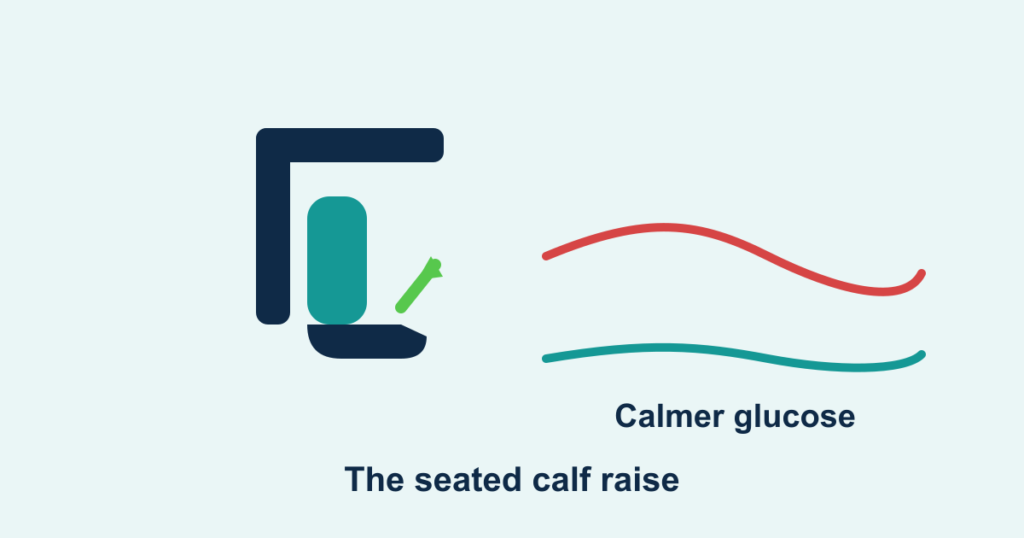
In a 2022 study published in iScience, researchers at the University of Houston described what they called the “soleus push-up” — a slow, repeated raising of the heel while seated, which keeps that one calf muscle gently contracting. The result stopped people in their tracks: participants showed a large improvement in blood sugar control after meals and steadier energy metabolism, all while sitting down.
Why one small muscle does so much
The soleus is built differently from most of your muscles. It’s dominated by slow, fatigue-resistant fibers designed to work for hours without tiring — which is exactly what lets it keep burning fuel long after other muscles would quit. When you contract it repeatedly, it pulls glucose and fats out of your blood to power itself, and it does this in a way that doesn’t depend heavily on insulin. For anyone whose blood sugar rides a roller coaster after meals, that’s a meaningful lever.
A 2025 review in Frontiers in Endocrinology on the physiological processes that shape post-meal glucose tolerance reinforces the bigger picture: gentle, sustained muscle activity — not just hard exercise — can meaningfully improve how your body handles a meal. The soleus push-up is simply the most extreme, low-effort example of that principle.
How to do the soleus push-up
- Sit with your feet flat on the floor, knees bent at about 90 degrees.
- Keep the front of your foot planted and slowly raise your heels as high as you comfortably can.
- Lower them back down under control, and repeat — a steady, rhythmic bounce.
- Aim for a relaxed pace you can sustain for many minutes while you work, read, or watch TV. The magic is in the duration, not the intensity.
It pairs naturally with the other free, muscle-driven blood sugar tricks we’ve covered — like how your muscles pull glucose without insulin and a short walk after meals.
The honest caveat
This was an early study with a small number of participants, and the soleus push-up is not a replacement for regular exercise, a good diet, or diabetes medication — walking, strength training, and overall movement still deliver benefits this move can’t. Think of it as a bonus tool for the many hours you’re stuck sitting anyway: a way to keep a little metabolic engine running when you’d otherwise be completely still. For something that costs nothing and can be done invisibly under a desk, that’s a remarkable amount of value.
This article is for general education and is not medical advice. Talk with your doctor before changing your diet, exercise, medication, or sleep routine, especially if you have a health condition.
References
- A potent physiological method to magnify and sustain soleus oxidative metabolism improves glucose and lipid regulation. iScience, 2022. doi.org/10.1016/j.isci.2022.104869
- Physiological processes induced by different types of physical activity that either oppose or enhance postprandial glucose tolerance. Frontiers in Endocrinology, 2025. doi.org/10.3389/fendo.2025.1601474
- Centers for Disease Control and Prevention — Physical activity and diabetes. cdc.gov
Frequently asked questions
How many soleus push-ups should I do?
There's no fixed number — the benefit comes from sustained, rhythmic contraction over time, not intensity. Aim to keep the gentle heel-raising going for many minutes while you sit and work, rather than counting reps.
Does the soleus push-up really lower blood sugar?
In an early study from the University of Houston, sustained soleus contraction while seated improved post-meal glucose and fat metabolism for hours. It's a promising, low-effort tool, but it doesn't replace exercise, diet, or medication.
Can I do it at my desk?
Yes — that's the point. It's designed to be done seated and unnoticed, so you can keep a small metabolic engine running during the hours you'd otherwise be completely still.