📚 Part of our Heart Health Guide — an evidence-based guide.
Medically referenced. This article reports on large randomized controlled trials (VITAL, ViDA, D2d) and research reviews indexed by the NIH and published in Nature Reviews Endocrinology. It is not medical advice.
Vitamin D might be the most oversold supplement in the pharmacy — and, at the same time, one genuinely worth taking for some people. Both things are true, and the difference between them comes down to a single question: are you actually deficient?
The evidence here is unusually strong, because vitamin D has been tested the right way — in large randomized trials rather than just observational studies. And the results were humbling for the supplement industry.
What the Big Trials Found
Three major randomized controlled trials — VITAL, ViDA, and D2d — together enrolled more than 30,000 participants. The finding: in adults who already had adequate vitamin D levels, supplementation did not prevent cardiovascular events, did not prevent cancer, did not prevent type 2 diabetes, and did not reduce mortality.[1]
That’s about as clear as nutrition science gets. If your level is fine, taking more does not appear to buy you protection from the big diseases — no matter what the bottle implies.
Where It Genuinely Matters
Here’s the other half of the truth, and it’s important: vitamin D deficiency should always be corrected.[1] That’s not a small caveat — deficiency is common, and it has real consequences for bone health.
Post-hoc analyses of the large trials suggest that supplementing people who are deficient modestly slows age-related bone loss, may slow progression to type 2 diabetes, and improves lung function.[1] The benefit lives in fixing a deficit — not in topping up someone who’s already fine.
How Deficiency Is Defined
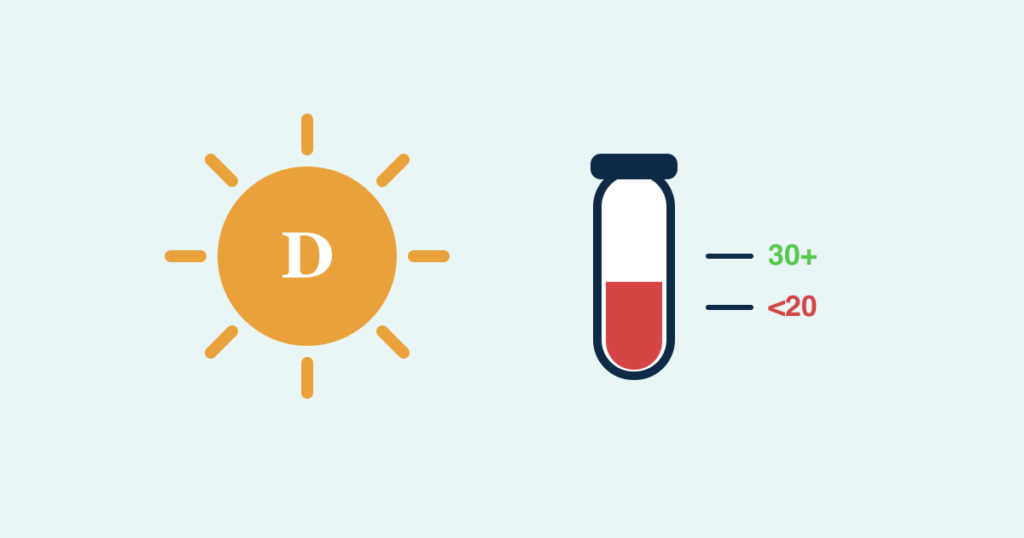
Vitamin D status is measured with a blood test for 25-hydroxyvitamin D. The standard interpretation:[2]
- Below 20 ng/mL — deficiency
- 20–30 ng/mL — insufficiency
- Above 30 ng/mL — generally considered sufficient
Which points to the single most useful action in this entire article: get tested rather than guess. A simple blood test converts this from a coin flip into a decision.
What About Safety?
Reassuringly, in randomized trials using doses from 5 to 175 micrograms per day, no adverse effects were reported.[3] Vitamin D at typical supplemental doses appears safe — though extremely high doses over long periods can cause harm, which is another reason to base the dose on a test and your doctor’s guidance rather than on a guess.
The Practical Bottom Line
- Don’t supplement blindly “for immunity” or “for the heart.” The large trials say that doesn’t work in people who are already replete.
- Do get your level checked if you have limited sun exposure, darker skin, obesity, older age, or a condition affecting absorption — all of which raise deficiency risk.
- If you’re deficient, correcting it is genuinely worthwhile — with a dose your doctor recommends.
- Don’t expect it to replace the fundamentals. Sleep, movement, and diet do far more for the outcomes people buy vitamin D hoping to influence.
This is exactly the kind of nuance that gets lost in supplement marketing: the answer isn’t “vitamin D is great” or “vitamin D is useless.” It’s that vitamin D fixes a deficiency, and fixing a deficiency is valuable — while taking extra when you don’t need it mostly produces expensive urine.
For our broader take on which supplements have real evidence behind them, see our evidence-checked supplement guide.
This article is for informational purposes only and is not a substitute for professional medical advice. Always consult a qualified healthcare provider before starting or changing any supplement.
References
- Bouillon R, et al. “The health effects of vitamin D supplementation: evidence from human studies.” Nature Reviews Endocrinology. nature.com
- “Vitamin D Deficiency.” StatPearls, NCBI Bookshelf. ncbi.nlm.nih.gov
- “Safety of Vitamin D Food Fortification and Supplementation: Evidence from Randomized Controlled Trials and Observational Studies.” NIH National Library of Medicine. ncbi.nlm.nih.gov
Frequently asked questions
Should everyone take vitamin D?
No. Vitamin D helps people who are genuinely deficient, but large trials show little benefit for those with adequate levels. Routine high-dose supplementing isn't needed for everyone.
Who actually benefits from vitamin D supplements?
People with low blood levels, limited sun exposure, darker skin, older adults, and certain medical conditions are most likely to benefit.
How do I know if I'm low on vitamin D?
A simple blood test measures your level. Rather than guessing, ask your doctor whether testing makes sense for you before supplementing.