📚 Part of our Sleep & Stress Guide — an evidence-based guide.
If someone told you that five minutes of a specific breathing pattern could lift your mood and calm your body more than five minutes of mindfulness meditation, you’d be right to be skeptical. Then a controlled study from Stanford tested exactly that — and the breathing won.
In a 2023 randomized trial published in Cell Reports Medicine, researchers had people practice one of several five-minute daily techniques for a month. One breathing pattern stood out for improving mood and lowering physiological arousal — including a slower resting breathing rate — and it edged out mindfulness meditation on several measures. The winner was something called cyclic sighing.
What cyclic sighing is
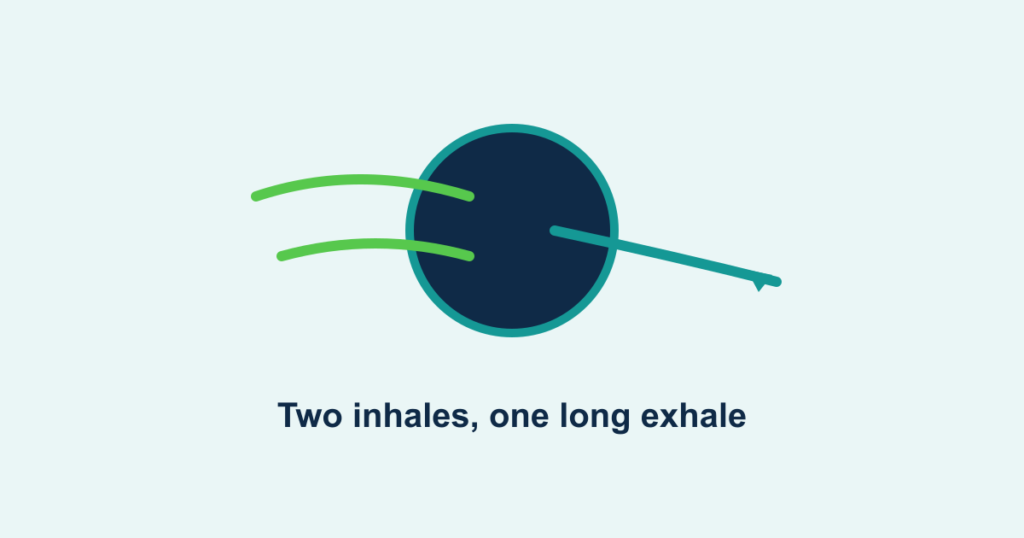
It’s built around the body’s own reset button. You’ve felt it after crying or when relief washes over you — that involuntary double inhale followed by a long exhale. Physiologically, that “sigh” re-inflates tiny collapsed air sacs in the lungs and offloads carbon dioxide efficiently, and the extended exhale strongly activates the calming, rest-and-digest branch of your nervous system. Cyclic sighing simply does this on purpose, in a rhythm.
How to do it
- Inhale slowly through your nose until your lungs feel comfortably full.
- Take a second, short sip of air in through your nose to top them off.
- Exhale slowly and completely through your mouth — make the out-breath long and unhurried.
- Repeat for about five minutes. The emphasis is always on a long, slow exhale.
What makes this finding so valuable is its accessibility: meditation asks you to master your attention, which many people find genuinely hard. Cyclic sighing asks only that you breathe in a certain shape — a physical action anyone can do on a stressful day, in a waiting room, or before sleep. Because stress, sleep, and blood sugar share the same wiring, calming one tends to help the others — as we explain in how stress hits blood sugar and blood pressure together.
The honest caveat
This was a one-month study, and breathwork is a tool for everyday stress and mood — not a treatment for clinical anxiety, depression, or panic disorder, which deserve professional care. Meditation still has its own deep and well-documented benefits; this isn’t a knockout of mindfulness so much as good news that there’s more than one path to calm. But if you’ve tried to meditate and bounced off it, the research offers a refreshing alternative: sometimes the fastest way to steady your mind is simply to change how you breathe.
This article is for general education and is not medical advice. Talk with your doctor before changing your diet, exercise, medication, or sleep routine, especially if you have a health condition.
References
- Brief structured respiration practices enhance mood and reduce physiological arousal. Cell Reports Medicine, 2023. doi.org/10.1016/j.xcrm.2022.100895
- National Center for Complementary and Integrative Health — Relaxation techniques for health. nccih.nih.gov
- National Institute of Mental Health — Caring for your mental health. nimh.nih.gov
Frequently asked questions
What is cyclic sighing?
It's a breathing pattern of two inhales through the nose followed by a long, slow exhale through the mouth, repeated for about five minutes to calm the body.
Is cyclic sighing better than meditation for stress?
In a Stanford trial, five minutes of daily cyclic sighing improved mood and lowered physiological arousal, edging out mindfulness meditation on several measures.
How long should I practice it?
About five minutes a day, always emphasizing a long, slow exhale. It's a tool for everyday stress, not a treatment for clinical anxiety or panic disorder.