📚 Part of our Sleep & Stress Guide — an evidence-based guide.
Melatonin is the best-selling sleep supplement in the United States, sold in doses that would have startled the researchers who first studied it, to millions of people using it for a problem it was never especially good at solving. It does work — but for something more specific than most buyers realize, and the gap between what it does and what it is sold for is where most disappointment comes from.
What melatonin actually is
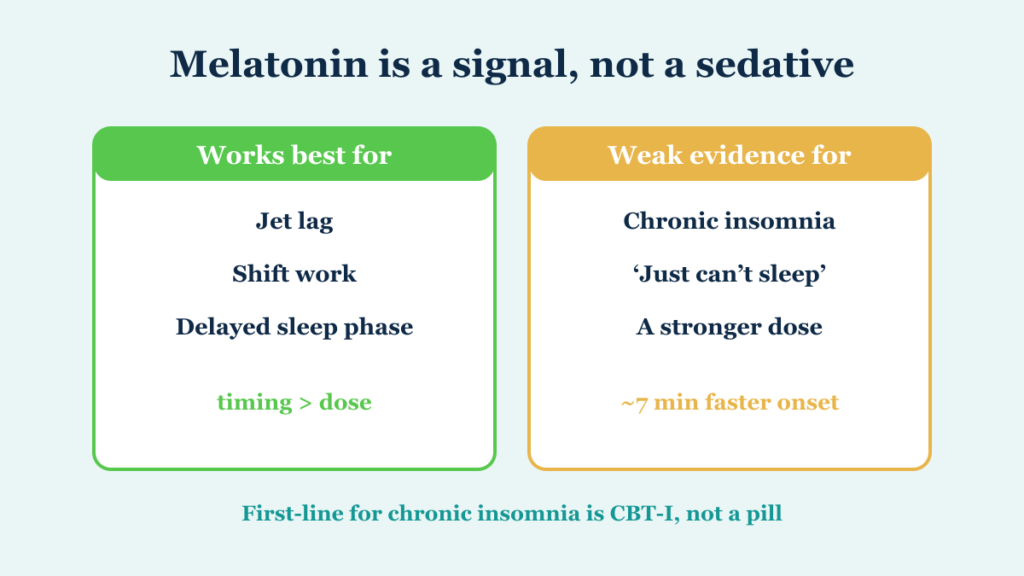
Melatonin is a hormone your brain releases as darkness falls. Its job is to tell your body that night has arrived. It is a timing signal, not a sedative — it does not knock you out the way a sleeping pill does, and expecting that is the single most common reason people conclude it “doesn’t work.”
Understanding that distinction tells you almost everything about when it helps. If your problem is that your internal clock is pointed at the wrong time, a timing signal is exactly the right tool. If your problem is a racing mind at a perfectly normal bedtime, it is not.
Where the evidence is strongest
Melatonin performs best for circadian misalignment — situations where your body clock and your schedule genuinely disagree:
Jet lag, particularly travelling eastward, where you need to advance your clock. This is the clearest use case.
Delayed sleep-wake phase disorder, the pattern in people who naturally fall asleep at 3 a.m. and would sleep until noon if allowed. Low-dose melatonin taken well before target bedtime can shift the clock earlier.
Shift work, where it can help consolidate daytime sleep, though results are more mixed.
In all three, melatonin works with light exposure rather than instead of it. Morning light is the more powerful lever of the two and it is free — see morning light for better sleep.
Where the evidence is weaker
For ordinary insomnia in adults, meta-analyses find melatonin helps people fall asleep faster by a genuinely small margin — on the order of seven minutes — with modest increases in total sleep time. That is a real effect. It is also far smaller than the marketing implies, and smaller than what good sleep habits deliver.
It is worth being direct about the alternative: for chronic insomnia, the recommended first-line treatment is cognitive behavioral therapy for insomnia (CBT-I), not medication or supplements. CBT-I outperforms sleeping pills over the long run and its benefits persist after treatment ends. If you have been sleeping badly for more than a few weeks, that is the intervention worth pursuing — background in what causes insomnia.
Timing matters more than dose
This is the most actionable thing in this article, and it is the opposite of how most people use it.
For simply nudging sleep onset, melatonin is typically taken 30 to 60 minutes before bed. But for shifting your clock earlier — the thing it is genuinely good at — it usually needs to be taken several hours before your target bedtime, not at bedtime. Taken too late, it can do very little for phase shifting.
On dose: more is not better. Low doses in the range of 0.5 to 1 mg are often as effective as 5 or 10 mg, and sometimes more effective for circadian shifting, because physiological doses mimic the body’s own signal. Higher doses are more likely to leave you groggy the next morning. Most products on U.S. shelves are sold at 5 or 10 mg, which is far above what the research supports for most uses — starting low and staying there is the sensible default.
The supplement quality problem
This deserves more attention than it gets. In the United States, melatonin is regulated as a dietary supplement rather than a drug, which means the contents are not verified before sale.
Independent analyses of commercial melatonin products have repeatedly found actual melatonin content deviating substantially from what the label claims — in both directions, sometimes by very large margins — with gummies among the most variable. Some analyzed products have also been found to contain serotonin, which does not belong in a melatonin supplement at all.
The practical defense is to buy products carrying independent third-party verification, such as a USP or NSF mark. It does not guarantee efficacy, but it does mean someone checked that the bottle contains what the label says.
Safety, side effects and children
Short-term use is generally well tolerated in adults. The most common effects are next-morning grogginess, headache, dizziness, and vivid dreams — grogginess especially at the high doses commonly sold.
Long-term safety data are limited. Melatonin has been widely used for years, but that is not the same as having good long-term trials, and it is honest to say the evidence base thins out past a few months of continuous use.
Melatonin can interact with blood thinners, immunosuppressants, seizure medications, blood pressure drugs, and diabetes medications. It is not recommended in pregnancy or breastfeeding, where data are insufficient.
On children: use has risen sharply, and so have calls to poison control centers involving pediatric melatonin ingestion — a pattern driven partly by gummies that look and taste like candy. Melatonin does have legitimate uses in children, particularly in certain neurodevelopmental conditions, but it should be a decision made with a pediatrician rather than a default. Store it where children cannot reach it.
What to try before or alongside it
Nearly everything with better evidence than melatonin costs nothing. A consistent wake time is the highest-yield sleep habit there is, and it matters at least as much as total hours (the research). Bright light in the morning and dim light in the evening do what melatonin is trying to do, more powerfully. A cooler bedroom supports the temperature drop sleep requires, and late caffeine undoes more sleep than most people realize.
If you fall asleep fine but cannot stay asleep, melatonin is particularly unlikely to help — see why you wake up at night and how to fall asleep faster. On the other popular supplement in this category, our read is in magnesium: what the evidence supports.
When to see a doctor
Skip the supplement aisle and book an appointment if you snore loudly, gasp or choke at night, or wake unrefreshed despite adequate hours — that points toward sleep apnea, which melatonin will not touch (warning signs). Also see a doctor if poor sleep has lasted more than a few weeks, if daytime sleepiness affects your driving or work, if you take any of the interacting medications above, or before giving melatonin to a child.
The honest bottom line
Melatonin is a clock signal, and it earns its place when your clock is the problem — jet lag, shift work, a sleep phase that runs too late. For general insomnia it produces a small effect, roughly seven minutes faster to sleep, well short of what the packaging suggests. If you use it, take a low dose and pay attention to timing rather than strength, choose a third-party-verified product, and treat it as a supplement to consistent wake times and morning light rather than a replacement for them. And if the problem has lasted weeks, the intervention with the strongest evidence is not on a shelf — it is CBT-I.
A widely shared study has since linked long-term melatonin use to higher heart failure risk — here is why the design cannot support that conclusion.
Frequently asked questions
Does melatonin actually help you sleep?
Modestly. Meta-analyses find it helps people fall asleep about seven minutes faster, with small gains in total sleep time. It works considerably better for circadian problems such as jet lag or a delayed sleep phase than for ordinary insomnia.
What is the best dose of melatonin?
Lower than most products sold. Doses of 0.5 to 1 mg are often as effective as 5 or 10 mg and less likely to cause next-morning grogginess. For shifting your body clock, when you take it matters more than how much.
Is it safe to take melatonin every night?
Short-term use is generally well tolerated in adults, but long-term safety data are limited. It can interact with blood thinners, seizure, blood pressure, diabetes and immunosuppressant medications, and is not recommended in pregnancy. If you need it nightly for more than a few weeks, that is worth discussing with a doctor.