🔬 Part of our Breakthroughs coverage — significant research, reported with its limits.
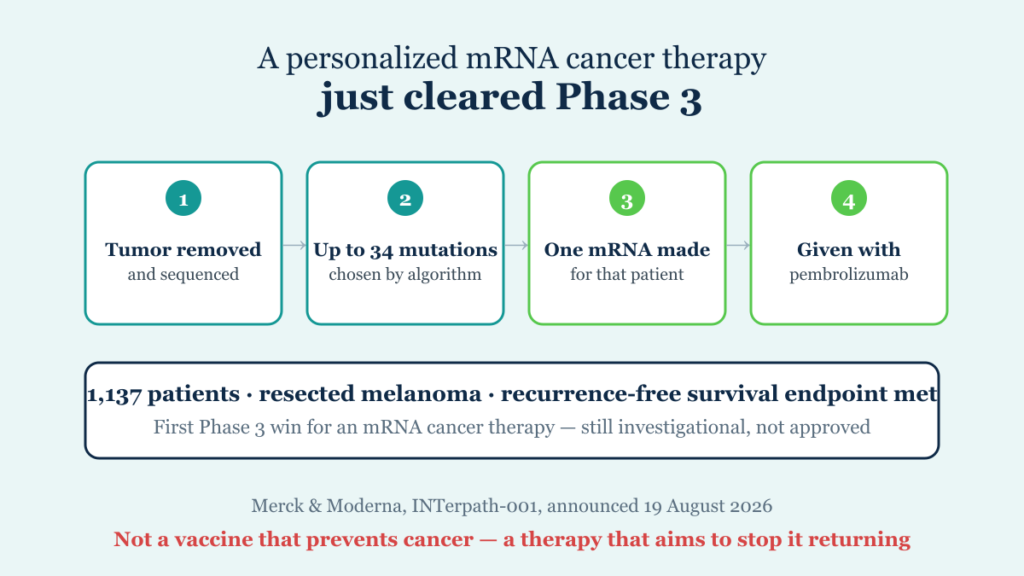
On 19 August 2026, Merck and Moderna announced that a Phase 3 trial of a personalized mRNA cancer therapy had met its primary endpoint. It is the first time an individualized neoantigen therapy — and the first time any mRNA-based cancer treatment — has succeeded in a Phase 3 trial.
That is a genuine milestone, and it is also narrower than the headlines suggest. Before anything else, two clarifications that change how you should read every number below.
This is not a vaccine that prevents cancer. It does not work like a flu shot or the HPV vaccine. It is given to people who already had cancer, after surgery has removed it, to reduce the chance of it coming back. The word “vaccine” describes the mechanism — training the immune system to recognise something — not the purpose.
It is not approved and not available. As of this writing it remains investigational. The only way to receive it is in a clinical trial.
What was actually announced
The trial is INTerpath-001 (ClinicalTrials.gov identifier NCT05933577). It enrolled 1,137 patients with completely resected stage IIB–IV cutaneous melanoma who had not received prior systemic therapy, randomised 2:1.
One group received intismeran autogene — the therapy’s name, previously known as mRNA-4157 or V940 — at 1 mg every three weeks for up to nine doses, combined with pembrolizumab (Keytruda) at 400 mg every six weeks for up to nine cycles. The comparator group received pembrolizumab alone. Treatment ran about 56 weeks.
At a pre-specified interim analysis, the combination met the primary endpoint of recurrence-free survival and the key secondary endpoint of distant metastasis-free survival. Safety was described as consistent with earlier studies, with no new safety signals.
Here is what the announcement did not include, and it matters: no hazard ratios, no confidence intervals, no percentages. The companies said the endpoints were met and that full data will be presented at a medical meeting. Until then, nobody outside the trial — including us — can judge the size of the benefit.
What this therapy actually is
Every tumour accumulates mutations. Some of those mutations produce proteins that are structurally different from anything in healthy tissue. Those altered proteins are called neoantigens, and they are, in principle, the perfect target: they exist only on the cancer, so an immune attack against them should spare normal cells.
The difficulty is that neoantigens are almost entirely unique to each person. Two patients with the same diagnosis will have different mutations, which means a single off-the-shelf product cannot target them.
Intismeran solves this by being manufactured individually. Each dose encodes up to 34 neoantigens selected from that specific patient’s tumour, strung together on a single mRNA molecule and wrapped in a lipid nanoparticle — the same delivery technology used in the COVID-19 mRNA vaccines.
How it works, step by step
1. The tumour is removed and sequenced. Surgery is the starting point, so this approach only applies where the cancer can be resected. Genetic sequencing compares tumour DNA with the patient’s healthy DNA to find the mutations unique to the cancer.
2. An algorithm picks the targets. A tumour may carry hundreds of mutations, and most would make poor targets — the resulting fragments have to bind the patient’s particular MHC molecules to be displayed to the immune system at all. Computational prediction ranks candidates and selects up to 34 with the best chance of provoking a response. This selection step is where much of the intellectual work sits, and where the approach can fail.
3. A bespoke mRNA is synthesised. The chosen sequences are assembled into one molecule — a concatemer — and encapsulated in lipid nanoparticles. Published descriptions of the platform put construct generation at roughly two to four weeks from sequencing, though real-world turnaround including logistics is longer.
4. The body makes the proteins itself. This is the elegant part. The injection does not deliver the neoantigens; it delivers the instructions. Antigen-presenting cells take up the mRNA, translate it, and display the resulting fragments on their surface via MHC molecules — the normal machinery of adaptive immunity, borrowed to introduce the immune system to targets it had been ignoring.
5. T cells learn the targets and patrol. The aim is a population of T cells primed to recognise those specific neoantigens, ready to destroy any residual cancer cells left behind after surgery before they establish a new tumour.
Why it is given with pembrolizumab
The two drugs address different halves of the same problem, which is why they are tested together rather than separately.
Pembrolizumab is a checkpoint inhibitor. Tumours exploit a molecular brake — the PD-1/PD-L1 pathway — to switch off T cells that come near them. Pembrolizumab releases that brake. But releasing a brake only helps if there are T cells that recognise the tumour in the first place.
Intismeran creates those T cells. Pembrolizumab keeps them working. The hypothesis behind the whole programme is that the combination should outperform either alone, and the Phase 3 result is the first Phase 3 evidence supporting it.
How it all started
The idea is older than the technology. Researchers have understood since the 1990s that tumour-specific mutations could serve as immune targets. What was missing was a way to find them quickly and cheaply, and a way to deliver them.
Genomic sequencing solved the first problem as costs collapsed through the 2010s. mRNA solved the second, and the timeline of this particular drug tracks that convergence:
- 2017 — Moderna begins development of the individualized neoantigen therapy programme. The first-in-human Phase 1 trial, KEYNOTE-603, launches in August.
- May 2018 — Moderna and Merck announce their collaboration, pairing Moderna’s mRNA platform with Merck’s pembrolizumab.
- 2019 — Trials begin in resected melanoma.
- 2020–2021 — The COVID-19 pandemic does something unplanned for oncology: it validates mRNA as a platform at enormous scale, and forces the build-out of manufacturing capacity and regulatory familiarity that cancer programmes then inherit. This is a real and underappreciated part of the story.
- December 2022 — The Phase 2b KEYNOTE-942 trial reports a 44% reduction in the risk of recurrence or death.
- February 2023 — The FDA grants Breakthrough Therapy designation for adjuvant treatment of resected high-risk stage III/IV melanoma.
- April 2023 — The European Medicines Agency grants PRIME designation.
- 2023 — The Phase 3 INTerpath-001 trial begins, alongside an expanding programme in other cancers.
- June 2026 — Five-year follow-up from KEYNOTE-942 is presented at the ASCO annual meeting.
- 19 August 2026 — INTerpath-001 reports that it met its primary and key secondary endpoints.
Nine years from programme start to a positive Phase 3. By oncology standards that is fast; by the standards of the news cycle that greeted the 2022 result, it was a long wait.
The evidence, in order
Reading the trials in sequence matters, because each answered a different question and each has different weight.
Phase 2b KEYNOTE-942 — the original signal
This was a randomised trial in 157 patients with high-risk stage III/IV melanoma after complete resection, randomised 2:1 to intismeran plus pembrolizumab or pembrolizumab alone.
The December 2022 result: a 44% reduction in the risk of recurrence or death, hazard ratio 0.56 (95% CI, 0.31–1.08; one-sided p=0.0266).
That confidence interval deserves attention, because it is routinely omitted from coverage. It crossed 1.0. The upper bound of 1.08 means the data were compatible with a small chance of no benefit at all. The result was reported as statistically significant on a pre-specified one-sided test, which was the trial’s design — but a 157-patient Phase 2b with a confidence interval touching 1.0 is a promising signal, not proof. Much of the 2022 press treated it as the latter.
Five-year follow-up — the signal held
Presented at ASCO in June 2026, with a median five years of follow-up:
- Recurrence-free survival: 49% reduction in risk of recurrence or death (HR 0.510; 95% CI, 0.294–0.887)
- Distant metastasis-free survival: 59% reduction (HR 0.411; 95% CI, 0.200–0.843)
Both intervals now exclude 1.0, and the effect did not fade with time — which is the more meaningful finding. Durability is exactly what you want from an immune-based therapy, and exactly what could not be assumed in 2022.
Phase 3 INTerpath-001 — the confirmation
Seven times larger than the Phase 2b, double-blind, and placebo- and active-comparator-controlled. It met both endpoints. This is the trial that matters for approval, and it is why the announcement is significant rather than merely interesting.
But, again: the numbers have not been released. We know the endpoints were met. We do not know by how much.
What we still do not know
This section is longer than most coverage will give you, and it is the part worth reading twice.
Nobody has seen the Phase 3 numbers. A topline announcement that endpoints were “met” is compatible with a large benefit and with a modest one. Wait for the conference presentation and peer-reviewed publication.
Recurrence-free survival is not the same as living longer. This is the most important caveat in the entire story. RFS measures time until the cancer comes back. Overall survival data are still immature — the trial continues to follow it as a secondary endpoint. Delaying recurrence is genuinely valuable, but oncology has repeated examples of therapies that improved progression or recurrence endpoints without translating into longer life. Until overall survival reads out, the claim that this helps people live longer is not established.
It is melanoma, so far. Melanoma is unusually immunogenic — it carries a high mutation burden, which means more neoantigens to target, and it responds better to checkpoint inhibitors than most cancers. A result here does not automatically transfer to tumours with few mutations, such as most pancreatic and prostate cancers.
Not everything in the programme has worked. INTerpath-007, a Phase 2/3 trial in cutaneous squamous-cell carcinoma, was terminated. Programme setbacks rarely make headlines, and mentioning them is part of reporting the picture honestly.
Cost and access are unresolved. Every dose is manufactured for one person. That model does not benefit from the economies of scale that make conventional drugs affordable, and it requires sequencing infrastructure, computational pipelines and cold-chain logistics. Nothing has been said about price. Realistically, this will be expensive, and equitable access is a genuine open question rather than a detail.
It requires resectable disease. The whole approach starts with a tumour sample and a surgery that removes the cancer. People with widespread metastatic disease at diagnosis are not the population studied here.
Safety, as reported
In the Phase 2b trial, serious treatment-related adverse events occurred in 14.4% of patients receiving the combination, compared with 10% receiving pembrolizumab alone. The Phase 3 announcement stated that safety was consistent with earlier studies, with no new signals.
Detailed Phase 3 adverse event rates — grade 3 or higher events, discontinuation rates, the specific pattern of side effects — have not been published. Adding any therapy to a checkpoint inhibitor generally adds toxicity, and full data are needed before anyone can characterise the trade-off properly.
Beyond melanoma
The programme extends well past skin cancer, and these trials are the real test of whether this is a platform or a single success:
- INTerpath-002 — Phase 3, resected non-small cell lung cancer
- INTerpath-004 — Phase 2, renal cell carcinoma after nephrectomy
- INTerpath-011 — Phase 2, high-risk non-muscle-invasive bladder cancer, combined with BCG
- INTerpath-013 and -014 — further non-small cell lung cancer studies
- INTerpath-007 — cutaneous squamous-cell carcinoma, terminated
Lung cancer is the one to watch. It is far more common than melanoma and also carries a relatively high mutation burden, which makes it a plausible next target — and a much larger public health question.
Moderna and Merck are not alone in this field. BioNTech has run personalized neoantigen work in pancreatic and colorectal cancer, and several academic groups are pursuing similar approaches. We have covered a related effort in personalized cancer vaccines in glioblastoma.
Can you get it?
Not outside a trial. It is investigational, has no regulatory approval anywhere, and Breakthrough Therapy and PRIME designations are mechanisms to speed up review — they are not approvals and do not indicate that approval is certain.
If you or someone close to you has resected melanoma or another cancer in the programme, enrolment in a trial is the only route, and that is a conversation with an oncologist. Searching ClinicalTrials.gov for “intismeran” or “INTerpath” shows which studies are recruiting and where.
A warning worth stating plainly: news like this reliably produces clinics and websites offering “personalized cancer vaccines” for payment. What is described in this article exists only inside registered clinical trials at established cancer centres. Anything sold to you directly is not this.
Why this matters beyond melanoma
Strip away the specifics and the significance is about a method, not a product.
For decades, therapeutic cancer vaccines were a graveyard of promising ideas. The concept was sound and the results were disappointing, largely because the targets used were shared tumour antigens that the immune system had already learned to tolerate.
Two things changed. Sequencing became cheap enough to read an individual tumour’s mutations in days. And mRNA became a manufacturing platform that can be reprogrammed by changing a sequence rather than rebuilding a production line — the same property that let COVID-19 vaccines be designed in weeks.
A positive Phase 3 says that combination can work in humans, at scale, in a rigorous trial. Whether it works in cancers with fewer mutations, whether it extends life rather than delaying recurrence, and whether health systems can afford a drug manufactured one patient at a time — all of that is unanswered.
That is still a meaningful shift. It is not a cure for cancer, and describing it as one does a disservice to people who will read that phrase with more hope than the evidence supports.
What to do with this information
If you have had melanoma removed, this is worth raising with your oncologist — not because you can get the drug, but because trial eligibility is a real conversation and adjuvant treatment decisions are made in a window after surgery.
If you do not have cancer, this changes nothing about your risk today. The things that reduce melanoma risk remain unglamorous and effective: sun protection, avoiding tanning beds, and having changing moles checked. And no cancer therapy in development substitutes for the ordinary levers covered elsewhere on this site — not smoking, staying active, keeping metabolic health in range, and attending screening.
The honest bottom line
A personalized mRNA therapy became the first of its kind to succeed in a Phase 3 trial, in patients whose melanoma had been surgically removed. The therapy is built individually from each patient’s tumour, encodes up to 34 of their own cancer’s mutations, and is given alongside a checkpoint inhibitor.
The result is real and the durability at five years in the earlier trial is encouraging. But the Phase 3 numbers have not been released, overall survival is not yet known, it has only been proven in one unusually immune-responsive cancer, and it is not approved or available. It is the strongest evidence yet that this approach works — and it is a long way from a cure for cancer.
Sources
Primary sources for this article, all publicly available:
- Merck & Moderna — Phase 3 INTerpath-001 topline announcement (19 August 2026)
- Merck & Moderna — five-year KEYNOTE-942 data (ASCO 2026)
- Merck & Moderna — original Phase 2b KEYNOTE-942 results (13 December 2022)
- ClinicalTrials.gov — INTerpath-001 (NCT05933577)
- ClinicalTrials.gov — KEYNOTE-942 (NCT03897881)
- Moderna newsroom — INTerpath-001
This article reports on investigational research and is general education, not medical advice. Treatment decisions belong with your oncologist. Nothing here should be used to delay or change cancer treatment.
Frequently asked questions
Is the Moderna cancer vaccine available yet?
No. Intismeran autogene is investigational and has no regulatory approval anywhere. The only way to receive it is by enrolling in a clinical trial. FDA Breakthrough Therapy and EMA PRIME designations speed up review but are not approvals.
Does the Moderna cancer vaccine prevent cancer?
No. It is not preventive like a flu or HPV vaccine. It is given to people whose cancer has already been surgically removed, to reduce the chance of it returning. The word vaccine refers to how it trains the immune system, not to preventing the disease.
How does a personalized mRNA cancer vaccine work?
The patient's tumour is sequenced to find mutations unique to their cancer. An algorithm selects up to 34 of these neoantigens, which are encoded into a single mRNA molecule. The body translates that mRNA and displays the fragments to the immune system, training T cells to recognise and attack any remaining cancer cells.