📚 Part of our Blood Sugar Guide — an evidence-based guide.
Metabolic syndrome is one of the most consequential diagnoses in medicine that almost nobody can define. It is not a disease in itself. It is a cluster of five measurements that, when three or more drift out of range together, sharply raises your risk of type 2 diabetes, heart disease, and stroke — and roughly one in three American adults meets the criteria.
The reason it matters is that each of those five numbers can look merely “borderline” on its own. Your blood pressure is a little high. Your triglycerides are a little high. Your waist has crept up. Individually, none of it triggers alarm. Together, they describe a body that is losing its ability to handle fuel — and the combined risk is greater than the sum of the parts.
The five criteria
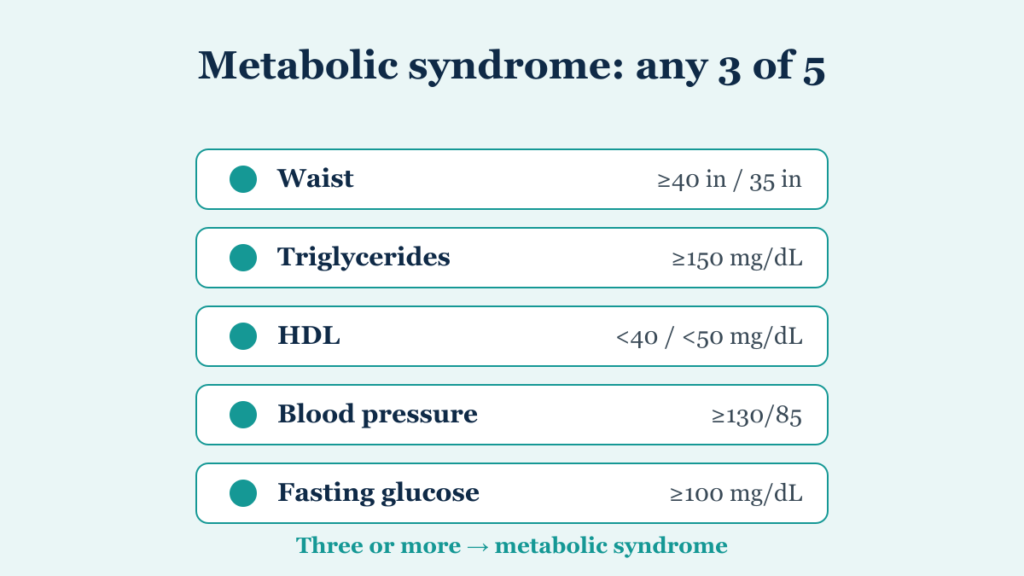
The definition used in the United States comes from a harmonized statement issued by major cardiology and diabetes organizations. You have metabolic syndrome if three or more of the following are true:
- Waist circumference of 40 inches (102 cm) or more in men, or 35 inches (88 cm) or more in women.
- Triglycerides of 150 mg/dL or higher — or you are being treated for high triglycerides.
- HDL cholesterol below 40 mg/dL in men or below 50 mg/dL in women — or you are being treated for low HDL.
- Blood pressure of 130/85 mmHg or higher — or you are on blood pressure medication.
- Fasting glucose of 100 mg/dL or higher — or you are being treated for high blood sugar.
Two details are easy to miss. First, being treated for one of these counts as having it — medication controls the number, not the underlying problem. Second, the thresholds are lower than the ones that define the individual diseases. A blood pressure of 132/86 is not hypertension, and a fasting glucose of 104 is not diabetes. But in this context they count, because the syndrome is about the pattern, not any single reading.
Why these five, and not others?
Because they are the visible fingerprints of one underlying process: insulin resistance.
When your cells respond poorly to insulin, your pancreas compensates by producing more of it. Chronically elevated insulin promotes fat storage in the abdomen, drives the liver to pump out triglyceride-rich particles, lowers HDL, and contributes to sodium retention and stiffer blood vessels — which nudges blood pressure up. Meanwhile glucose starts to drift because the compensation is no longer quite enough.
So the five criteria are not an arbitrary checklist. They are five different windows onto the same room. That is also why they tend to move together, and why fixing one often improves the others.
Why waist circumference, not BMI
The definition deliberately uses a tape measure rather than the scale, and this is one of its most useful features. Fat stored around and inside the abdominal organs — visceral fat — is metabolically active in a way that fat under the skin of the hips and thighs is not. It releases free fatty acids and inflammatory signals directly into the portal circulation feeding the liver.
This is why two people at the same weight can have completely different metabolic profiles, and why you can meet the criteria at a perfectly ordinary BMI. We covered that trap in normal-weight obesity and the broader case in why waist size predicts health better than the scale.
Measure at the top of your hip bones, at the end of a normal exhale, with the tape snug but not compressing. Do not measure at the narrowest point, and do not hold your breath.
What it actually predicts
Metabolic syndrome roughly doubles the risk of cardiovascular disease and increases the risk of developing type 2 diabetes several-fold compared with people who do not have it. It is also associated with fatty liver disease, chronic kidney disease, sleep apnea, and certain cancers.
Those numbers deserve a caveat, though, and it is an important one: metabolic syndrome is a risk marker, not a mechanism of its own. Some researchers argue the label adds little beyond simply treating each abnormal number on its merits, and there is genuine debate about whether the cluster is more than the sum of its parts. Our read: the clinical argument is unsettled, but the practical value is real, because the label makes people take a set of borderline numbers seriously instead of dismissing each one in isolation.
How to reverse it
Here is the encouraging part. Because all five criteria share one root cause, the interventions that improve insulin sensitivity tend to move several numbers at once. You do not need five separate strategies.
Lose a modest amount of weight, if you carry excess. Losing 5–7% of body weight preferentially reduces visceral fat and improves every one of the five criteria. This is the same threshold that drove the results in the Diabetes Prevention Program — see can you reverse prediabetes?
Build and use muscle. Contracting muscle pulls glucose from the blood through an insulin-independent pathway (how that works), and more muscle means more capacity to store glucose safely. Combine aerobic activity with strength training twice a week.
Change the shape of your carbohydrate intake, not just the amount. Fiber and protein blunt glucose and insulin spikes; refined carbohydrate and liquid sugar do the opposite. Start with carb quality and meal order.
Target triglycerides specifically. They respond faster than almost any lipid marker to reduced alcohol, reduced added sugar, and weight loss — see triglycerides.
Attack blood pressure with sodium and potassium together. The DASH diet was built for exactly this, and it overlaps heavily with everything above.
Protect sleep. Short and irregular sleep worsen insulin resistance and blood pressure directly (the connection), and screening for sleep apnea matters here — it is strongly associated with metabolic syndrome and frequently undiagnosed (warning signs).
What to ask your doctor
You can find out whether you meet the criteria at a single ordinary appointment. You need a blood pressure reading, a waist measurement, and a fasting lipid panel plus fasting glucose — all routine and inexpensive. Ask specifically for the triglyceride and HDL values, not just total cholesterol, since total cholesterol will not tell you what you need to know here.
If you meet three or more criteria, that is a reason to act, not to panic. Ask what your individual risk looks like, whether an A1C would add information, and whether anything in your current medication list is contributing. And be realistic about medication: lifestyle change is genuinely powerful for this cluster, and it is not always enough on its own.
The honest bottom line
Metabolic syndrome is what happens when five borderline numbers stop being independent. The label exists because doctors kept seeing the same five things travel together, and because the combination predicts far more trouble than any one of them alone. Whether it deserves to be called a distinct syndrome is still argued in the literature — but nobody argues about what to do next, and that is what makes it useful. Measure your waist, get a fasting panel, count how many boxes you tick, and treat the underlying insulin resistance rather than five separate problems.
If your risk sits in the uncertain middle, a coronary calcium score often resolves the treatment decision.
Frequently asked questions
What are the five criteria for metabolic syndrome?
A waist of 40 inches or more in men (35 in women), triglycerides of 150 mg/dL or higher, HDL below 40 mg/dL in men (50 in women), blood pressure of 130/85 or higher, and fasting glucose of 100 mg/dL or higher. You need three or more, and being treated for one counts as having it.
Can metabolic syndrome be reversed?
Often, yes. Because all five criteria stem largely from insulin resistance, losing about 5-7% of body weight, adding strength training and regular activity, improving carbohydrate quality, and treating poor sleep can move several of the numbers back into range.
Is metabolic syndrome the same as diabetes?
No. It is a cluster of risk factors that sharply raises the chance of developing type 2 diabetes and heart disease. Its glucose threshold (100 mg/dL fasting) is well below the diabetes range, which is the point: it identifies risk before disease.