📚 Part of our Weight Loss Guide — an evidence-based guide.
Medically referenced. This article reports on a consensus statement published in Nature Reviews Endocrinology and research indexed by the NIH. It is not medical advice.
Step on a scale and it tells you how heavy you are. It doesn’t tell you where the fat is — and when it comes to health, location matters more than weight. Two people can weigh the same and carry profoundly different risk, and the difference often comes down to one measurement a tape can capture in ten seconds: your waist.
This is the third in our small series on the simple body signals that predict health — alongside your resting heart rate and grip strength.
🧮 Try our free calculator — waist-to-height ratio calculator. Check your own ratio in seconds.
Not All Fat Is Equal
The fat you can pinch under the skin — subcutaneous fat — is relatively harmless. The dangerous kind is visceral fat: the fat packed deep in your abdomen, wrapped around your liver, pancreas, and intestines. It’s metabolically active in the worst way, pumping out inflammatory signals and disrupting how your body handles insulin and blood fats. Excess visceral fat is directly linked to higher risk of type 2 diabetes, heart disease, and other cardiometabolic conditions.[1]
This is why waist size can matter more than total weight: a large waist is a visible clue that visceral fat is accumulating where it does the most damage.
The Numbers Worth Knowing
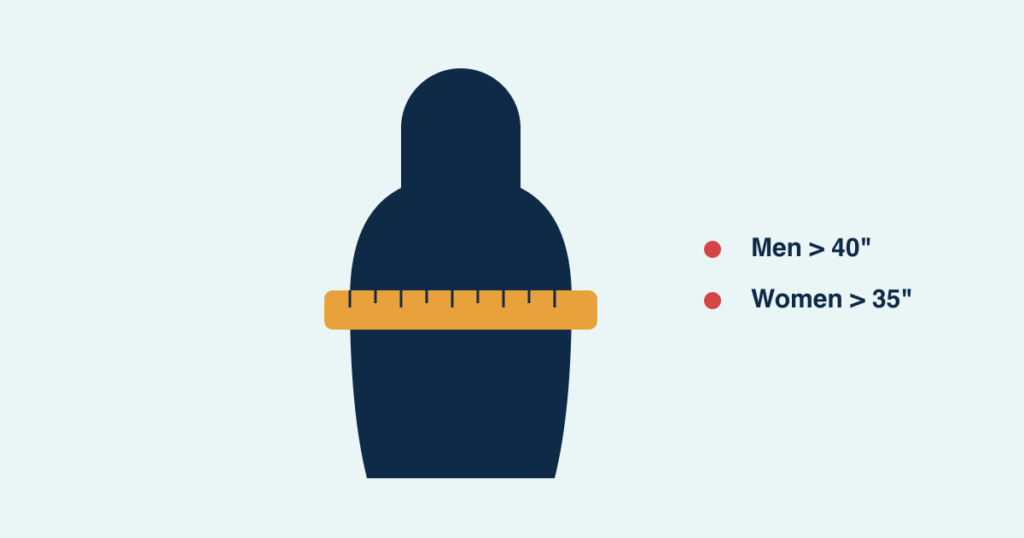
Waist circumference is used clinically as a practical stand-in for visceral fat. The commonly cited risk thresholds:[2]
- Men: a waist over 40 inches (102 cm) signals increased cardiometabolic risk
- Women: a waist over 35 inches (88 cm) signals increased cardiometabolic risk
An international expert consensus has gone as far as recommending that waist circumference be treated as a “vital sign” in routine clinical practice — measured as normally as blood pressure.[2] That’s how seriously the evidence takes it.
How to Measure It Right
The method matters, because a sloppy measurement is worse than none:
- Use a flexible tape, directly against the skin, standing up and relaxed.
- Place it around your midsection at the level of the top of your hip bones, roughly level with your navel.
- Measure after a normal exhale — don’t suck in.
- Track the trend over months, not day-to-day fluctuations.
Combined with the scale, waist size gives a far better read on risk than weight alone. Two people at the same BMI can sit on opposite sides of the risk line depending on their waist.
The Good News: Visceral Fat Responds First
Here’s what makes this measurement genuinely motivating: visceral fat is often the first fat to go when you improve your habits. The same fundamentals that show up across this site — regular movement (even strength work), a diet built on protein and fiber instead of ultra-processed foods, better sleep, and less chronic stress — preferentially shrink the dangerous visceral fat, often before the scale moves much. A shrinking waist can be a better sign of progress than a falling weight.
An Honest Limit
Waist circumference is a useful proxy, not a perfect one. Only imaging (like an MRI or CT scan) directly measures visceral fat, and tape measurements vary with technique.[1] But as a free, ten-second tool you can use at home to watch your risk respond to your choices, it’s hard to beat — and far more informative than the scale alone.
This article is for informational purposes only and is not a substitute for professional medical advice. Always consult a qualified healthcare provider about cardiometabolic risk and weight management.
References
- Research on visceral adipose tissue and cardiometabolic disease. NIH National Library of Medicine. ncbi.nlm.nih.gov
- “Waist circumference as a vital sign in clinical practice: a Consensus Statement from the IAS and ICCR Working Group on Visceral Obesity.” Nature Reviews Endocrinology. nature.com
New evidence supports this directly — waist circumference performed as well as multi-measurement obesity definitions.
Frequently asked questions
Is waist size a better health measure than weight?
For many people, yes. Waist circumference reflects abdominal fat, which is more strongly tied to heart and metabolic risk than total body weight or BMI alone.
How do I measure my waist correctly?
Measure around your bare abdomen at the level of the top of your hip bones, after breathing out normally — not pulling the tape tight.
What waist size raises health risk?
General guidance links higher risk to roughly over 40 inches in men and 35 inches in women, though individual risk varies — use it as one signal among several.