📚 Part of our Heart Health Guide — an evidence-based guide.
Medically referenced. This article reports on peer-reviewed research including a meta-analysis published in the Canadian Medical Association Journal (CMAJ). It is not medical advice.
There’s a health number you can check in about thirty seconds, with no device more advanced than a finger and a clock — and it quietly predicts more than most people realize. Your resting heart rate: the number of times your heart beats per minute when you’re calm and still. A large meta-analysis found that for every 10 beats-per-minute increase in resting heart rate, the risk of dying from any cause rose by about 9%.[1] A simple number, a meaningful signal.
Here’s how to read yours — and what it’s actually telling you.
What Counts as Normal
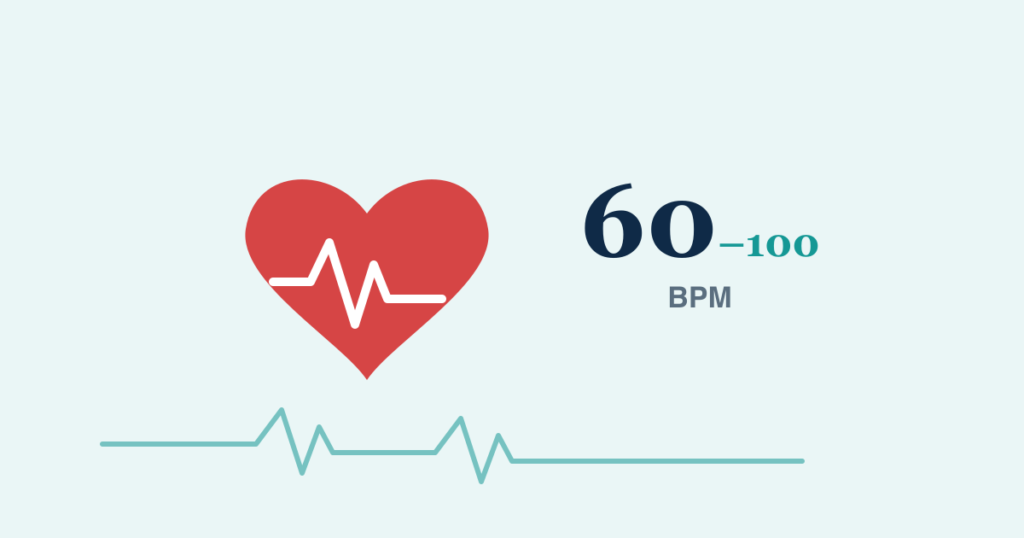
A resting heart rate between 60 and 100 beats per minute is generally considered normal.[1] But “normal” and “optimal” aren’t the same thing. Within that range, lower tends to be better: research consistently finds that people at the higher end carry more risk than those at the lower end, even when both are technically “normal.”[1] Well-trained endurance athletes often sit in the 40s and 50s — a sign of a heart efficient enough to do more with each beat.
Why the Number Matters So Much
A resting heart rate isn’t random — it reflects what’s happening under the hood. A persistently elevated resting rate signals sympathetic overactivity: your “fight or flight” nervous system idling too high. Over time, that’s linked to greater strain on the heart, higher oxygen demand, stiffer arteries, and the processes that drive cardiovascular disease.[1] Think of it as your body’s resting engine speed. An engine that idles high is working harder than it should just to sit still.
How to Measure It Properly
- Measure when truly at rest — ideally in the morning, before coffee, before getting out of bed.
- Find your pulse at your wrist or neck, count the beats for 30 seconds, and multiply by two.
- Track the trend, not a single reading. One number is a snapshot; the pattern over weeks is the real signal. A wearable can make this effortless, but a finger works fine.
What Pushes It Up — and What Brings It Down
The encouraging part is how responsive this number is to the same fundamentals we cover across this site. Things that raise resting heart rate include poor sleep, chronic stress, dehydration, too much caffeine, and being out of shape. Things that lower it over time include regular aerobic exercise, better sleep, and stress management.
That overlap is not a coincidence. Your resting heart rate is, in a sense, a running scoreboard for your lifestyle — which is why it so often moves in step with your blood pressure, your sleep, and your stress levels. Improve those, and your resting heart rate usually follows.
When to Pay Closer Attention
A consistently high resting heart rate (regularly above 100 at rest), a sudden unexplained change, or a rate paired with symptoms like dizziness, breathlessness, or palpitations is worth raising with your doctor rather than tracking alone. This number is a useful early signal, not a diagnosis — and it’s most powerful as a prompt to look closer, not as a verdict.
The point of knowing it is empowerment: one easy measurement that turns an abstract idea — “cardiovascular health” — into something you can actually watch respond to the choices you make.
This article is for informational purposes only and is not a substitute for professional medical advice. Always consult a qualified healthcare provider about heart rate concerns or symptoms.
References
- Zhang D, et al. “Resting heart rate and all-cause and cardiovascular mortality in the general population: a meta-analysis.” CMAJ. cmaj.ca
Frequently asked questions
What is a healthy resting heart rate?
For most adults, a normal resting heart rate is about 60-100 beats per minute, and a lower rate within that range often signals better fitness.
What does a high resting heart rate mean?
A persistently elevated resting heart rate can reflect poor fitness, stress, dehydration, or an underlying issue worth discussing with your doctor.
How can I lower my resting heart rate?
Regular aerobic exercise, good sleep, stress management, and staying hydrated tend to lower resting heart rate over time.