📚 Part of our Weight Loss Guide — an evidence-based guide.
Creatine is the strangest success story in the supplement aisle. It is cheap, it has been studied for more than thirty years, hundreds of randomised trials have tested it, and the effect it produces is small but genuinely real — which puts it in a category almost nothing else on the shelf occupies.
It is also now being sold for things the evidence does not support. So it is worth separating the three claims: what creatine reliably does, what it might do, and what is being oversold.
What creatine actually is
Your body already contains roughly 120 to 140 grams of creatine, about 95% of it stored in skeletal muscle. You make about half of it yourself in the liver and kidneys; the rest comes from meat and fish. A vegetarian typically carries lower muscle stores than someone who eats red meat.
Its job is to buffer energy. Muscle runs on ATP, but a working muscle holds only two or three seconds of it. Phosphocreatine donates a phosphate group to regenerate ATP almost instantly — which is why creatine matters for efforts lasting a handful of seconds and matters progressively less as duration grows.
Supplementing raises muscle stores by roughly 20 to 40%, and that ceiling is the reason the effect is bounded. You cannot keep loading a full tank.
The claim that holds up
For short, intense, repeated efforts, creatine works. Meta-analyses of resistance-training trials consistently find that creatine plus training produces modestly greater gains in strength and lean mass than training alone — on the order of one to two kilograms of additional lean mass and a few percent more strength over 6 to 12 weeks.
Two things deserve emphasis, because they are usually left out.
First, creatine does nothing without the training. It is not an anabolic agent. It lets you complete perhaps one or two more repetitions at a given load, and across weeks that extra work accumulates into a slightly larger adaptation. Remove the training and you remove the effect.
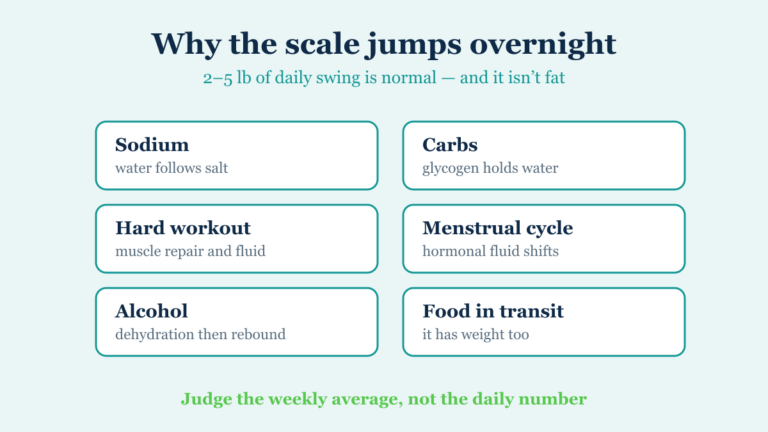
Second, part of the early weight gain is water. Creatine is osmotically active and pulls fluid into muscle cells, which typically shows up as one to two kilograms on the scale in the first week. That is not fat and it is not muscle. People who do not expect it often quit at exactly the point the supplement is starting to work.
The size of the effect is also not uniform. Roughly 20 to 30% of people are “non-responders” — usually those whose muscle stores were already near saturation, which tends to mean high meat intake. Vegetarians, starting lower, often respond most.
The brain claim: interesting, not established
The brain also uses phosphocreatine, and this has driven a wave of marketing about memory, focus and mood. Here the evidence is thinner than the advertising suggests, but it is not nothing.
The most consistent signal appears under stress. Trials in sleep-deprived participants have reported better performance on demanding cognitive tasks with creatine, and the effect appears larger the more depleted the person is. Vegetarians have shown cognitive improvements in some trials where meat-eaters showed little or none — consistent with the pattern in muscle: you benefit from filling a tank that was not full.
In well-rested, well-fed, omnivorous adults, effects on memory and reasoning have been small and inconsistent.
There is early work on creatine as an adjunct in depression and on brain energy metabolism after concussion. Both are legitimate research questions. Neither is settled, and neither justifies the claims being made about them. If someone is selling creatine for cognition, they are selling ahead of the data.
The safety question
Creatine monohydrate has an unusually long safety record for a supplement. Trials running up to five years in healthy adults have not found kidney or liver damage.
The kidney concern comes from a measurement artifact worth understanding, because it causes real confusion at the doctor’s office. Creatine breaks down into creatinine, and serum creatinine is what labs use to estimate kidney function. Supplementing raises creatinine slightly without any change in actual kidney filtration — so an eGFR can look mildly worse on paper while the kidney is doing exactly what it did before. Tell your doctor you take it, or a cystatin C test can settle the question directly.
That reassurance applies to people with normal kidney function. If you have existing kidney disease, this is a conversation for your nephrologist, not a comment section.
The other honest caveat is manufacturing. Supplements are not reviewed for safety and effectiveness before sale in the U.S., so third-party testing — NSF Certified for Sport or Informed Sport — is doing real work here.
How it is actually taken
Three to five grams of creatine monohydrate daily. That is the whole protocol.
Monohydrate is the form used in nearly every trial and it is the cheapest one on the shelf. The premium forms — hydrochloride, buffered, ethyl ester — have not demonstrated superiority to it. When a more expensive version of a well-studied compound arrives without evidence that it works better, the price is buying novelty.
Loading — 20 g daily for five to seven days — saturates muscle faster, in about a week rather than three to four. It reaches the same endpoint. It also causes more of the gastrointestinal complaints people report. If you are not in a hurry, skip it.
Timing is close to irrelevant. Stores are what matter, and they take weeks to build and weeks to fall.
Where it fits
Creatine is a small, reliable addition to resistance training — and resistance training is the thing doing the work. If you are not lifting, creatine has almost nothing to act on. The case for preserving muscle gets stronger with age, and it matters more than most people realise for whether fat loss lasts (why muscle, not the scale, decides) and for how well you are ageing overall (what grip strength predicts).
It also will not substitute for protein intake, which most people undershoot (how much you actually need), or for meeting basic activity levels (what the guidelines require).
When to talk to a doctor
Ask before starting if you have kidney disease, are pregnant or breastfeeding, or take medication affecting kidney function. Mention it before any blood work so a raised creatinine is not misread. Stop and seek advice for persistent swelling, marked reduction in urine output, or unexplained muscle pain with dark urine.
The honest bottom line
Creatine monohydrate does a small thing well: it lets a training muscle do slightly more work, and over months that becomes slightly more strength and lean mass. The safety record is strong, the price is low, and the evidence base is far better than almost anything sold beside it. The brain claims are running well ahead of the data — plausible under sleep deprivation, unproven in a rested adult. And none of it substitutes for the training that makes it work at all.
Frequently asked questions
Does creatine work without exercise?
Not meaningfully. Creatine is not an anabolic agent; it buffers energy so a working muscle can complete slightly more work at a given load. That extra work is what drives the adaptation. Without training there is almost nothing for it to act on, beyond the water drawn into muscle cells.
Is creatine bad for your kidneys?
There is no evidence of kidney damage in healthy adults, including in trials running up to five years. The confusion comes from a measurement artifact: creatine breaks down into creatinine, which is what labs use to estimate kidney filtration, so eGFR can look mildly worse on paper without any real change. A cystatin C test settles it. People with existing kidney disease should ask their nephrologist.
How long does creatine take to work?
About three to four weeks at 3–5 g daily to saturate muscle stores, or about a week with a 20 g loading phase. Both reach the same endpoint. Loading causes more gastrointestinal complaints, so it is worth it only if you are in a hurry.
Which form of creatine is best?
Monohydrate. It is the form used in nearly every trial and it is the cheapest available. Hydrochloride, buffered and ethyl ester versions have not shown superiority to it in head-to-head research. Look for NSF Certified for Sport or Informed Sport testing, since supplements are not reviewed for safety and effectiveness before sale.
Do you need to cycle creatine?
No. There is no evidence that continuous use causes tolerance or downregulation, and no trial support for cycling. Stores fall back to baseline over roughly four to six weeks after stopping.