📚 Part of our Heart Health Guide — an evidence-based guide.
Almost everyone has heard a number — 30 minutes a day, 10,000 steps, three gym sessions a week — without knowing where it came from or what it is supposed to accomplish. The actual guidelines are more specific than the folklore, more flexible than most people assume, and considerably more encouraging about small amounts of activity than they used to be.
Here is what the U.S. Physical Activity Guidelines for Americans actually recommend, what the evidence behind each number looks like, and how to think about it if you are starting from nothing.
The headline numbers
For adults, the recommendation has two independent parts, and both matter.
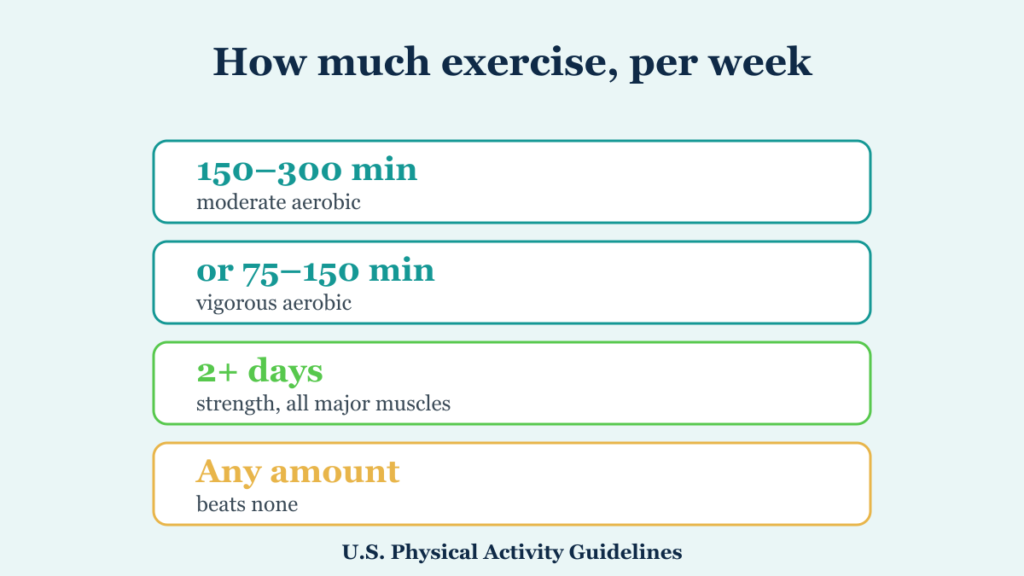
Aerobic activity: at least 150 to 300 minutes a week of moderate-intensity activity, or 75 to 150 minutes of vigorous-intensity activity, or an equivalent combination of the two. Vigorous minutes count double, so 30 vigorous minutes are equivalent to 60 moderate ones.
Muscle-strengthening activity: on two or more days a week, working all the major muscle groups — legs, hips, back, abdomen, chest, shoulders, and arms.
Older adults are advised to add balance training, and to be as active as their condition allows. That is the entire core recommendation. Note what it does not say: it prescribes no specific exercise, no gym, no particular schedule, and no minimum session length.
What “moderate” and “vigorous” actually mean
These are the terms people get wrong most often, usually by overestimating their own intensity.
Moderate means you are breathing harder than usual and could talk but not sing. Brisk walking, easy cycling, doubles tennis, water aerobics, and most yard work qualify. Your heart rate is elevated and you may break a light sweat, but you could sustain it for a long time.
Vigorous means you cannot say more than a few words without pausing for breath. Running, swimming laps, singles tennis, uphill hiking with a pack, and most interval work qualify.
The talk test is more reliable than a heart-rate formula for most people, and it costs nothing.
The change that matters most: the 10-minute rule is gone
Older guidance said aerobic activity only counted in bouts of at least 10 minutes. The current edition removed that requirement, because the accumulated evidence showed that shorter bursts count too.
This is not a technicality. It means the three minutes you spend on stairs, the seven-minute walk to the train, and the four minutes carrying groceries all contribute to your weekly total. For anyone who has ever concluded that they do not have time to exercise, this single change reframes the problem — you are not looking for an hour, you are looking for fragments.
It is also consistent with the research on breaking up sitting, which shows independent benefits from simply interrupting long sedentary stretches (the movement snack).
Where the biggest payoff hides
If you plot health outcomes against activity level, the curve is steepest at the very beginning. The difference between doing nothing and doing a little is far larger than the difference between doing a lot and doing more.
That is why the guidelines lead with the phrase “some physical activity is better than none.” The person who goes from zero to 60 minutes a week captures a substantial share of the total available benefit. The person going from 300 to 400 minutes is refining something that is already largely working.
This same pattern shows up in the step-count literature, where the mortality curve begins flattening well before the famous 10,000 — see how many steps you actually need.
Why strength training is not optional
The muscle-strengthening component is the half people skip, and it is doing work that cardio cannot.
Muscle is where most glucose gets stored after a meal, so more of it improves blood sugar handling directly. Strength predicts healthy aging in its own right — which is why something as simple as grip strength tracks so closely with outcomes. And muscle mass is what preserves function and independence in later decades, which no amount of walking fully replaces.
It also determines the composition of any weight you lose, which is the difference between fat loss that lasts and weight loss that rebounds (why muscle decides).
Two sessions a week, covering the major muscle groups, is the target. Bodyweight work, resistance bands, machines, and free weights all count.
Cardiorespiratory fitness: the number underneath the guidelines
The guidelines prescribe minutes because minutes are easy to count. But what those minutes are really buying is cardiorespiratory fitness — and that turns out to be one of the strongest predictors of lifespan we have, stronger than most conventional risk factors. We covered the size of that association in the fitness number that predicts lifespan.
The practical implication: if your weekly minutes are not translating into feeling fitter over months, adding some harder efforts — hills, intervals, faster stretches — will move fitness more than adding volume at the same easy pace.
What this does for blood pressure, glucose and weight
Exercise is the single most effective non-drug intervention for several of the numbers people care about. It lowers blood pressure, improves insulin sensitivity, raises HDL, and lowers triglycerides. For blood pressure specifically, it works alongside diet rather than instead of it — the full picture is in how to lower blood pressure naturally.
One honest exception: for weight loss specifically, exercise is a weaker lever than most people expect, because appetite and unconscious movement adjust to compensate. It is essential for keeping weight off and for health at any weight — but it is a poor primary tool for creating an energy deficit, which we unpack in why you can’t outrun a bad diet.
A realistic way to hit it
150 minutes sounds like a lot until you distribute it. Thirty minutes on five days is the obvious version, but so is a 20-minute walk after lunch plus a 10-minute one after dinner, six days a week. Two strength sessions of 25 minutes each will cover the second requirement.
If you are starting from a sedentary baseline, do not start at 150. Start at whatever you will actually repeat next week, and add roughly 10% per week. The most common failure mode is not insufficient ambition — it is a first week so aggressive that there is no second week.
When to check with a doctor first
Most healthy adults can begin moderate activity such as walking without medical clearance. Talk to a doctor first if you have known heart disease, have had chest pain or fainting with exertion, have poorly controlled blood pressure or diabetes, or are significantly deconditioned and planning to start vigorous exercise. Stop and seek care for chest pain or pressure, unusual shortness of breath, dizziness, or an irregular heartbeat during activity.
The honest bottom line
150 to 300 minutes of moderate aerobic activity a week plus two strength sessions is the target, vigorous minutes count double, and short bursts count toward the total. But the most useful thing in the guidelines is not any of those numbers — it is the finding that the return on the first few weekly minutes is enormous, and that the curve flattens after that. If you are at zero, you are standing at the steepest part of the curve. If you are already meeting the minimum, adding strength training will do more for you than adding cardio minutes.
Frequently asked questions
How much exercise do you need per week?
At least 150 to 300 minutes of moderate-intensity aerobic activity, or 75 to 150 minutes of vigorous activity, plus muscle-strengthening activity on two or more days a week covering all major muscle groups.
Does walking count as exercise?
Yes. Brisk walking is moderate-intensity activity and counts fully toward the weekly aerobic target. Since the 10-minute minimum bout was removed, even short walks throughout the day add to your total.
Is 30 minutes a day enough exercise?
Thirty minutes of moderate activity on five days meets the minimum aerobic recommendation of 150 minutes a week. You would still need to add strength training on two days to meet the full guideline.