📚 Part of our Weight Loss Guide — an evidence-based guide.
You did everything right. You ate carefully, you trained, you slept. You step on the scale and it is up three pounds. This is one of the most demoralizing experiences in weight loss, and it derails more attempts than any plateau — because it looks like proof that nothing works.
It is not proof of anything. Here is the arithmetic that should settle it, and the reasons the number moves the way it does.
The number that ends the argument
A pound of body fat stores roughly 3,500 calories. To genuinely gain three pounds of fat overnight, you would have to eat about 10,500 calories above what you burned — in a single day.
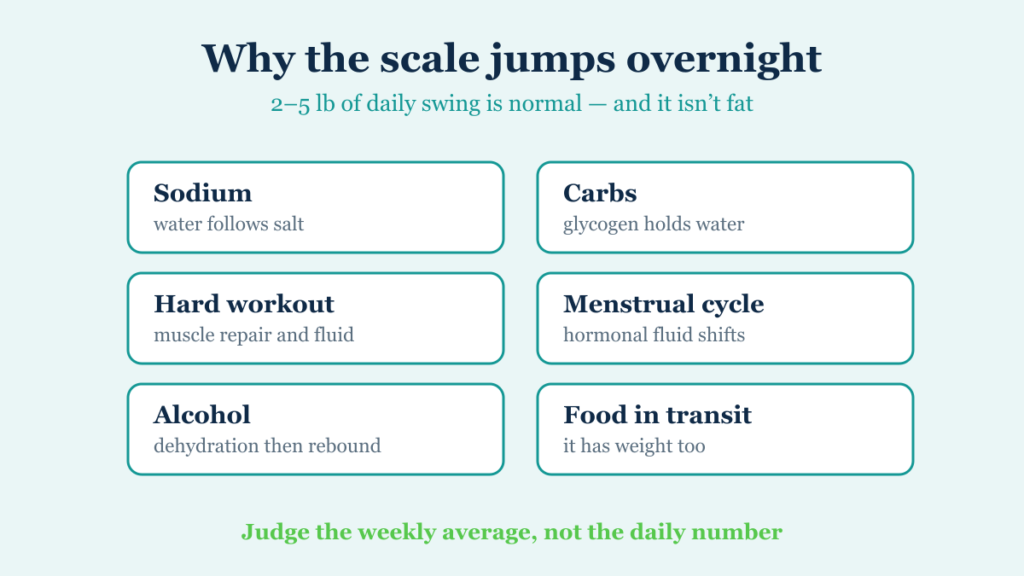
You did not do that. Almost nobody does. So whatever the scale is reporting, it is not overnight fat gain. It is water, food in transit, and normal physiological variation. Daily swings of two to five pounds are entirely ordinary, and larger swings are common in bigger bodies.
Where the weight actually comes from
Sodium. Your body holds water in proportion to sodium. A salty restaurant meal, takeout, or a bag of chips can add a pound or two of water within a day. It leaves on its own over the following days — and it says nothing about fat. Related: where sodium hides.
Carbohydrate. Your body stores carbohydrate as glycogen, and glycogen binds water — roughly three grams of water for every gram of glycogen. Eat more carbohydrate than usual and you gain water weight; cut carbohydrate sharply and you lose it fast. This is precisely why low-carb diets produce dramatic first-week results that are mostly water, and why those pounds return the moment carbohydrate does.
Hard exercise. A demanding or unfamiliar workout causes muscle damage, inflammation and fluid retention as tissue repairs. Starting a new training program frequently produces a small weight gain in the first weeks. This is the opposite of failure, and it is temporary.
The menstrual cycle. Hormonal shifts drive fluid retention that commonly adds one to five pounds in the days before menstruation, resolving afterward. Comparing this week to last week without accounting for cycle phase produces nonsense.
Food and waste in transit. Everything you have eaten and not yet processed has physical weight. A large meal, a high-fiber day, or a couple of days of constipation all register on the scale without changing your body composition at all.
Alcohol. It dehydrates you first, which can show a false drop, then produces rebound retention. Salty food alongside it compounds the effect.
Poor sleep and stress. Both raise cortisol, which promotes fluid retention — and both make the following day’s eating harder to control, which is the larger effect.
Weigh yourself properly, or not at all
Most of the noise people experience is self-inflicted through inconsistent measurement. If you are going to weigh, standardize it:
- Same time of day, first thing in the morning.
- After using the bathroom, before eating or drinking.
- Minimal, consistent clothing.
- Same scale, same spot on a hard floor — carpet genuinely changes the reading.
Weighing in the evening after a full day of food and fluid will read one to four pounds higher than the next morning. That difference is meaningless, but it feels like something.
Use the trend, not the number
This is the single change that makes the scale useful instead of upsetting.
Weigh daily if you can tolerate it, then judge yourself on the weekly average compared with the previous week’s average. Any individual reading is noise; the average is signal. Many tracking apps compute a smoothed trend line automatically, and it is far more informative than any single morning.
Expect real fat loss to appear at roughly 0.5 to 1% of body weight per week, and expect it to be lumpy — weeks of nothing followed by a sudden drop are extremely common, usually because retained water masked ongoing fat loss and then released. If you have been consistent for three or four weeks with no trend movement, that is the point to adjust, as covered in how many calories to eat and why am I not losing weight.
Measure things the scale cannot see
Body weight bundles fat, muscle, water, bone and gut contents into one number and refuses to say which changed. That is its central weakness — and it is why building muscle while losing fat can leave the scale motionless while your body changes substantially (why muscle decides).
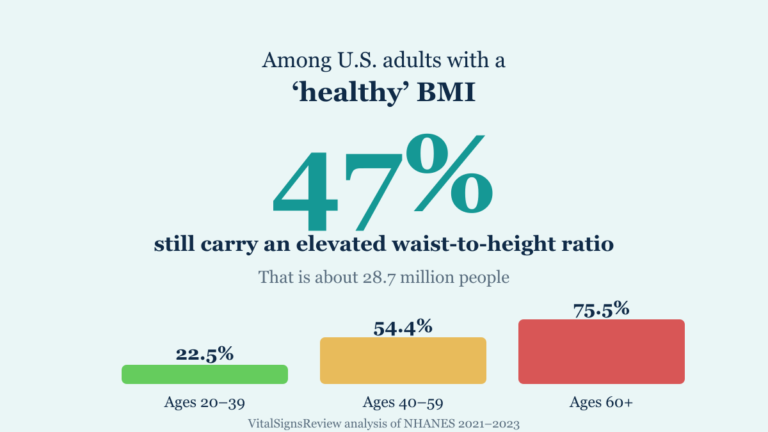
Track at least one thing besides weight: waist circumference, which predicts health better than the scale does (here’s why), how a specific pair of trousers fits, monthly photographs in consistent lighting, or strength in the gym. When the scale is being unhelpful, these usually are not.
If the scale genuinely distresses you
Worth saying plainly: daily weighing helps some people and harms others. If the number sets the tone of your day, or you find yourself compensating with restriction after a high reading, weekly weighing or no weighing is a legitimate choice. Waist measurements and how clothes fit track progress perfectly well. If weight or food has become a source of persistent anxiety, that is worth raising with a doctor.
When a change in weight needs a doctor
Rapid weight gain deserves medical attention rather than dietary analysis if it comes with swelling in the legs, ankles or abdomen, shortness of breath, or reduced urination — those suggest genuine fluid retention from a heart, kidney or liver cause. Also see a doctor for unexplained weight loss you did not intend, or for weight gain accompanied by fatigue, cold intolerance and constipation, which can point to an underactive thyroid.
The honest bottom line
Your weight fluctuates by two to five pounds a day because of sodium, carbohydrate, glycogen water, exercise repair, hormones and the food currently inside you. None of that is fat, and the 3,500-calorie arithmetic proves it. Weigh under identical conditions, judge the weekly average rather than the daily number, track your waist alongside it, and treat the scale as one noisy instrument among several — because that is exactly what it is.
Frequently asked questions
Why did I gain 3 pounds overnight?
Almost certainly water and food in transit rather than fat. Gaining three pounds of actual fat would require eating roughly 10,500 calories above what you burned in one day. Sodium, extra carbohydrate, a hard workout or hormonal fluid shifts explain nearly all overnight jumps.
How much weight fluctuation is normal in a day?
Two to five pounds is typical for most adults, and larger swings are common in bigger bodies. Weighing in the evening will read one to four pounds higher than the next morning simply from food and fluid consumed during the day.
Should I weigh myself every day?
Daily weighing works well if you judge the weekly average rather than individual readings, since it captures the trend faster. If the number affects your mood or drives compensatory restriction, weekly weighing or tracking waist size instead is a reasonable alternative.