📚 Part of our Weight Loss Guide — an evidence-based guide.
“How many calories should I eat to lose weight?” is one of the most searched health questions there is, and most answers hand you a number from a calculator with far more confidence than the underlying math deserves. The number is a useful starting point. It is not a measurement, and treating it as one is why so many people conclude their metabolism is broken.
Here is how to get a sensible starting estimate, and — more importantly — how to correct it using the only data that actually describes your body.
🧮 Try our free calculator — calorie target calculator. It shows the honest margin of error alongside the number.
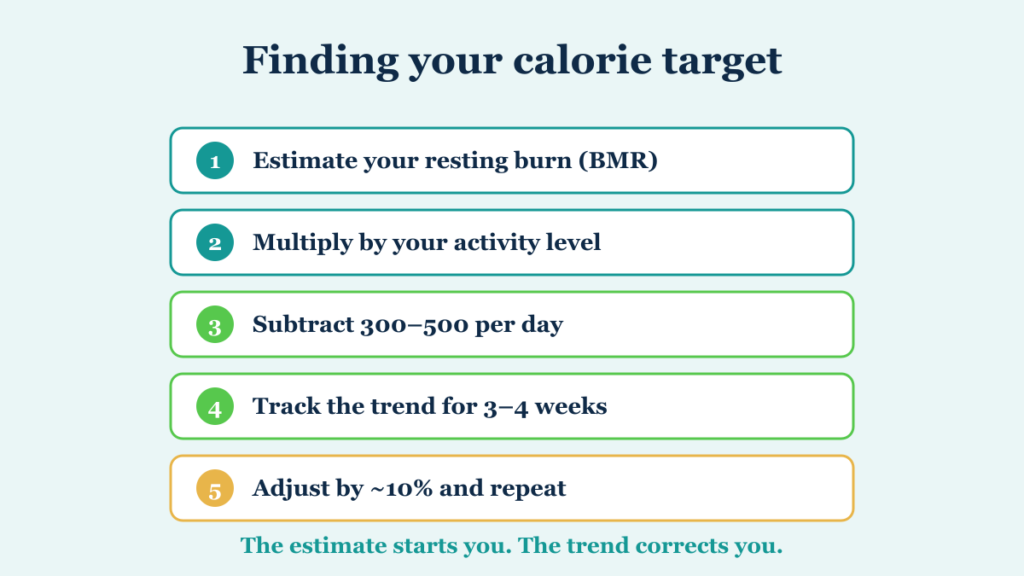
Step 1: estimate your resting burn
Your basal metabolic rate (BMR) is roughly what you would burn lying still all day. The Mifflin-St Jeor equation is the standard estimate:
- Men: (10 × weight in kg) + (6.25 × height in cm) − (5 × age) + 5
- Women: (10 × weight in kg) + (6.25 × height in cm) − (5 × age) − 161
To convert: pounds ÷ 2.205 = kg, and inches × 2.54 = cm. A 40-year-old woman at 165 lb (75 kg) and 5’5” (165 cm) lands around 1,420 calories.
Step 2: account for movement
Multiply your BMR by an activity factor to estimate total daily energy expenditure (TDEE):
- 1.2 — desk job, little deliberate activity
- 1.375 — light exercise 1–3 days a week
- 1.55 — moderate exercise 3–5 days a week
- 1.725 — hard exercise 6–7 days a week
Most people overestimate here. Choose the lower option when you are between two, because three gym sessions a week does not make an otherwise sedentary day “moderate.” Our example woman at 1.375 gets a TDEE of about 1,950.
Step 3: subtract a deficit you can live with
A deficit of 300 to 500 calories a day is the range most people can sustain. That puts our example at roughly 1,450–1,650 calories a day.
You will often read that 3,500 calories equals a pound of fat, so a 500-a-day deficit yields exactly a pound a week. That rule is a useful first approximation and it overestimates long-term loss, because your body adapts: as you get lighter you burn less, and metabolic rate falls somewhat more than body size alone predicts. Real-world loss slows over months even when adherence is perfect — this is expected physiology, not failure (why crash diets backfire).
Bigger deficits do not scale cleanly either. They increase muscle loss, worsen the hormonal hunger response, and raise the odds of abandoning the whole thing — the reason persistent hunger so often shows up at this stage (why am I always hungry).
Step 4: the part that actually matters
Here is what most calorie guides leave out. Prediction equations estimate an individual’s true energy expenditure with a substantial margin of error — commonly on the order of 20% in either direction. For our example woman, that is a range of roughly 1,560 to 2,340 calories. Two people identical on paper can differ by hundreds of calories a day.
So the calculator does not tell you your maintenance calories. It gives you a place to start. What tells you the truth is what happens next:
- Eat at your estimated target for three to four weeks.
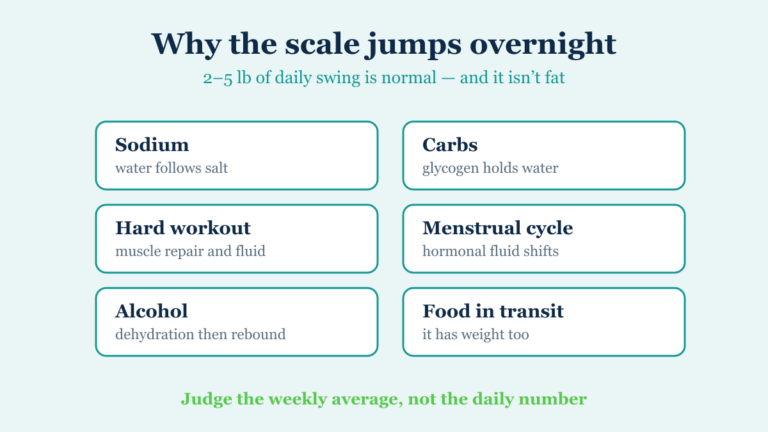
- Weigh yourself under consistent conditions and use the weekly average, not any single reading — daily weight swings several pounds on water alone.
- If you have lost roughly 0.5–1% of body weight per week, your estimate was good. If nothing moved after three consistent weeks, reduce by about 10% and reassess.
Three to four weeks is the minimum honest window, because water retention can mask real fat loss for two weeks or more.
The tracking problem nobody mentions
Studies comparing self-reported intake against objective measurement consistently find that people underreport what they eat — often substantially, and not because they are being dishonest. Cooking oils, dressings, drinks, bites while cooking, and eyeballed portions add up invisibly.
This has a practical consequence: if the scale is not moving on a supposed 1,500-calorie intake, the explanation is usually the measurement, not the metabolism. Weighing food for a week is tedious, but it recalibrates your eye and is far more informative than lowering the target further. More on the other stalls in why am I not losing weight.
How low is too low
Very low intakes cost you muscle, and muscle is what determines whether the loss lasts (why muscle decides). As a general floor, going below about 1,200 calories a day for women or 1,500 for men is not something to do without medical supervision — it makes adequate protein, vitamins and minerals genuinely hard to reach.
Whatever your target, protect two things inside it: enough protein to preserve muscle (how much you need) and enough fiber to make the deficit tolerable (the appetite tool). A deficit built on protein and fiber feels very different from the same deficit built on refined carbohydrate.
Should you add exercise to the deficit?
Add exercise for health, fitness, and muscle retention — not as your main lever for the deficit. Appetite and unconscious movement adjust to compensate for a meaningful share of what you burn, which is why exercise underperforms as a weight-loss tool despite working well for everything else (why you can’t outrun a bad diet).
One consequence: do not “eat back” the calories your watch says you burned. Those estimates are among the least accurate numbers in consumer fitness, and doing so frequently erases the deficit entirely.
You do not have to count at all
Worth saying plainly: calorie counting is one tool, not a requirement. Plenty of people lose weight by controlling food quality and portions without ever tracking a number — and for anyone with a history of disordered eating, counting can be actively harmful. If tracking makes you anxious or preoccupied, the structural approach in our evidence-based weight loss guide works without it.
When to talk to a doctor
Check in before starting if you are pregnant or breastfeeding, have diabetes and take insulin or medications that can cause low blood sugar, have a history of an eating disorder, are under 18, or have significant heart, kidney or liver disease. Also see a doctor if you are losing weight without trying, if you are eating at a reasonable deficit for six or more consistent weeks with no change at all, or if weight loss comes with fatigue, hair loss, or a loss of your menstrual cycle.
The honest bottom line
Estimate your BMR, multiply by an honest activity factor, subtract 300–500, and treat the result as a hypothesis rather than a prescription. The calculator can be off by hundreds of calories in either direction — only your own weight trend over three to four weeks can correct it. Keep protein and fiber high inside whatever number you land on, do not chase ever-lower targets when the scale stalls, and check your portions before you cut further. The number gets you started; the trend gets you there.
Frequently asked questions
How many calories should I eat a day to lose weight?
Estimate your resting burn with the Mifflin-St Jeor equation, multiply by an activity factor between 1.2 and 1.725, then subtract 300 to 500 calories. For many adults that lands somewhere between 1,400 and 2,000, but individual needs vary by hundreds of calories.
Is 1,200 calories a day too low?
For most women it is a practical floor rather than a target, and going below it without medical supervision makes adequate protein, vitamins and minerals hard to reach. For men the equivalent floor is around 1,500. Very low intakes also cost muscle.
Why am I not losing weight in a calorie deficit?
Most often the deficit is smaller than it appears, since self-reported intake is routinely underestimated. Other common reasons are water retention masking fat loss, judging progress over days rather than weeks, and eating back calories that a fitness tracker overestimated.