📚 Part of our Weight Loss Guide — an evidence-based guide.
Constant hunger gets treated as a discipline problem. It is almost never a discipline problem. Appetite is a regulated physiological signal, shaped by what you ate, how you slept, how much muscle you carry, what your hormones are doing, and sometimes by a medical condition or a medication. When you are hungry all the time, something is usually driving it — and most of the drivers are identifiable and fixable.
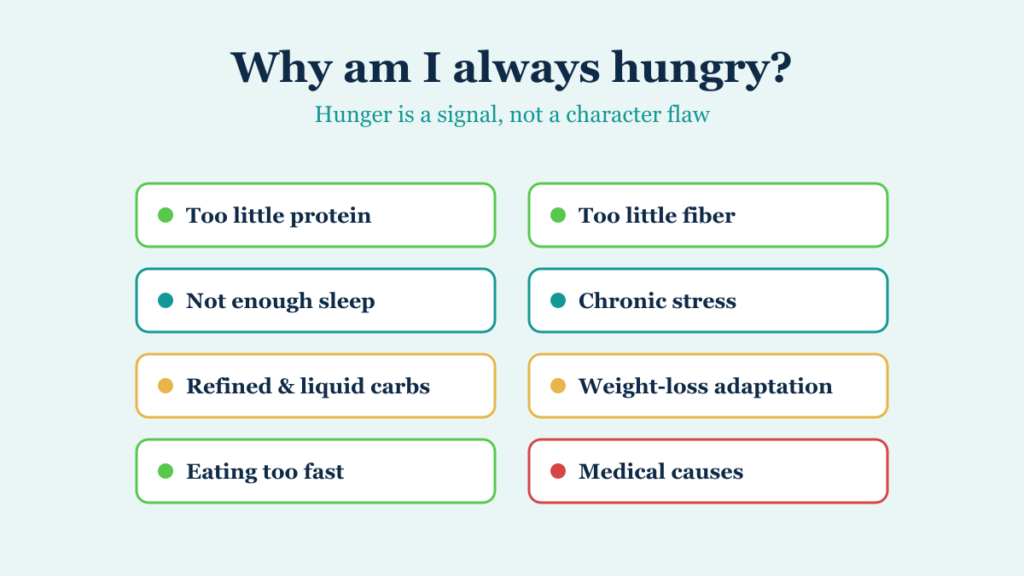
Here are the reasons with real evidence behind them, roughly in order of how often they turn out to be the explanation.
1. Not enough protein
Protein is the most satiating macronutrient by a wide margin. It slows gastric emptying and stimulates the gut hormones that tell your brain you have eaten. In controlled feeding studies, raising protein reliably reduces spontaneous calorie intake without anyone consciously restricting.
Most people undershoot, particularly at breakfast, which is where the effect is largest — a protein-rich first meal measurably reduces intake for the rest of the day (why it works). If your hunger is worst mid-morning or mid-afternoon, this is the first thing to check. For target amounts, see how much protein you actually need.
2. Not enough fiber — especially the viscous kind
Fiber adds volume and slows digestion, and the soluble, viscous types form a gel that dramatically slows how quickly a meal leaves your stomach. That is a mechanical brake on hunger for very few calories.
Oats, beans, lentils, barley, psyllium, chia, and apples are the useful sources. Details in why soluble fiber is one of the best appetite tools you’re not using. Combined with protein, it is the single most effective pairing for appetite — the research is summarized in protein + fiber.
3. Blood sugar swings from refined and liquid carbohydrate
A meal of rapidly absorbed carbohydrate with little protein or fiber produces a sharp glucose rise, a large insulin response, and then a dip that can land below where you started. That dip is felt as genuine hunger, often within two or three hours of eating.
Liquid calories are the worst offenders, because they arrive fast and register poorly — sweetened drinks, juice, and alcohol all deliver energy without meaningfully reducing appetite. The fix is not eliminating carbohydrate but changing its shape and its company: carb quality and eating fiber and protein first.
4. Short sleep
This one is underrated and remarkably consistent. Sleep restriction raises ghrelin, the hormone that signals hunger, and lowers leptin, which signals fullness. It also increases the appeal of energy-dense food specifically.
The effect is large enough to change body weight on its own: in a controlled study, losing roughly 80 minutes of sleep a night was enough to drive measurable weight gain (here’s why). If your hunger arrived at the same time as a new schedule, a new baby, or a run of late nights, start here rather than with your diet.
5. Chronic stress
Sustained stress raises cortisol, which increases appetite and shifts preference toward calorie-dense food. It also makes eating a regulation strategy rather than a response to hunger — which is worth naming honestly, because it does not respond to nutritional fixes.
Stress affects glucose and blood pressure through the same pathway (how that works). Interventions with real evidence and no cost include brief structured breathing and time in green space.
6. Your body is defending lost weight
If the hunger started after you lost weight, it is not imagined and it is not weakness. Weight loss triggers a coordinated hormonal response — ghrelin rises, satiety hormones fall, and energy expenditure drops more than body size alone predicts. The magnitude scales with how aggressive the deficit was, which is precisely why crash diets rebound (metabolic adaptation).
The practical answer is a smaller deficit, more protein, and enough strength training to preserve muscle (why muscle decides). This is a physiological headwind to plan around, not to out-willpower.
7. Eating too fast
Fullness signals take time to reach the brain. Eat quickly enough and you can comfortably finish far more than you needed before any of them arrive. Slowing down measurably reduces intake in controlled studies — the overlooked trick. It costs nothing and requires no change to what you eat.
8. Ultra-processed food
Food engineered for palatability is easy to overeat almost regardless of intention. In a tightly controlled inpatient trial where diets were matched for calories, sugar, fat, fiber and macronutrients, people eating the ultra-processed version consumed several hundred more calories a day and gained weight. That is not a moral failing — it is a property of the food. Background in what the research really shows.
9. A medical cause or a medication
Sometimes persistent hunger is a symptom. Uncontrolled diabetes classically causes intense hunger alongside thirst and frequent urination, because glucose cannot get into cells. An overactive thyroid raises appetite along with weight loss and a racing heart. Depression and anxiety change appetite in both directions.
Several common medications increase appetite too, including some antidepressants, antipsychotics, corticosteroids, and certain diabetes drugs. If your hunger changed noticeably after starting something new, that is worth raising with your prescriber rather than assuming it is behavioral.
What about drinking water?
You will read everywhere that thirst is commonly mistaken for hunger. We want to be straight with you: the evidence for that specific claim is weak. Drinking water before a meal does modestly reduce intake in some trials, mostly in older adults, and staying hydrated is worthwhile for other reasons — but “you’re not hungry, you’re thirsty” is repeated far more confidently than the data support. Try it if you like; do not expect it to solve genuine, persistent hunger.
When to see a doctor
Get checked if constant hunger is accompanied by unexplained weight loss, excessive thirst, frequent urination, blurred vision, a racing or irregular heartbeat, tremor, or heat intolerance. Also worth a conversation: hunger that started abruptly with no change in diet or activity, hunger severe enough to wake you at night, or hunger that began within weeks of a new medication. A fasting glucose, an A1C, and a thyroid panel answer most of these questions quickly.
The honest bottom line
Persistent hunger is information. In most people it points at one of four things: too little protein, too little fiber, too little sleep, or a deficit their body is actively defending. Those have concrete fixes, and they usually work within days rather than months. If none of them apply — or if hunger arrived suddenly, alongside other symptoms — the answer is a blood test, not more willpower.
Frequently asked questions
Why am I always hungry even after eating?
Usually because the meal was low in protein and fiber, or high in rapidly absorbed carbohydrate, which produces a glucose dip a couple of hours later that feels like genuine hunger. Short sleep and chronic stress amplify the effect through ghrelin and cortisol.
What deficiency causes constant hunger?
Constant hunger is more often driven by too little protein or fiber than by a vitamin deficiency. When it is medical, the usual culprits are uncontrolled diabetes or an overactive thyroid, both of which are easily checked with a blood test.
Does drinking water help with hunger?
Modestly at best. Water before a meal reduces intake somewhat in some trials, mainly in older adults, but the common claim that people routinely mistake thirst for hunger is not well supported by evidence.