📚 Part of our Blood Sugar Guide — an evidence-based guide.
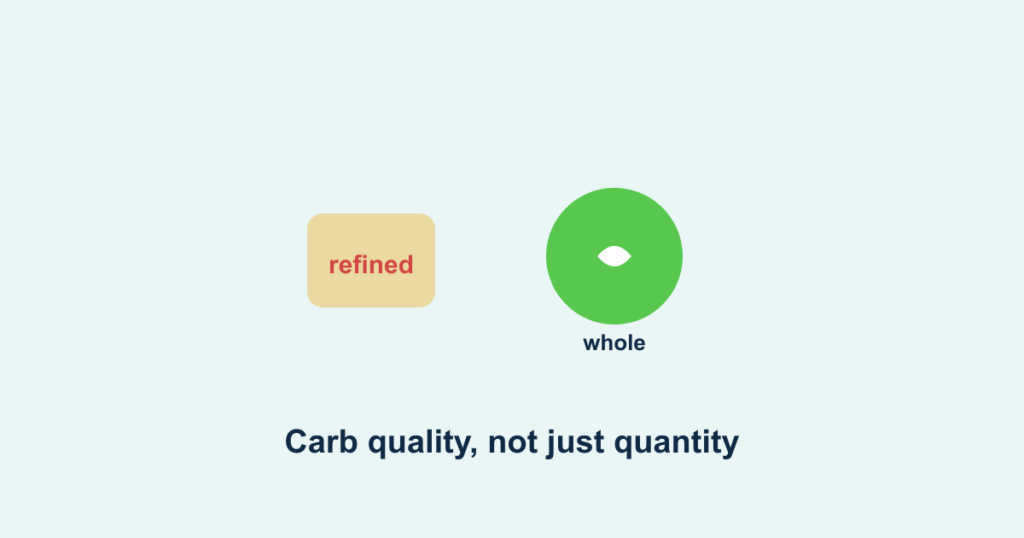
Most blood sugar advice reduces to a single instruction: eat fewer carbohydrates. It is not wrong, but it is incomplete — and it leads people to treat lentils and jellybeans as the same problem. The form a carbohydrate arrives in changes what it does to your blood sugar, sometimes more than the amount does.
Why identical carb counts behave differently
Forty grams of carbohydrate from steel-cut oats and forty grams from cornflakes are the same number on a label and a very different event in your bloodstream. Four things explain the gap.
Fiber, particularly the soluble, viscous kind, forms a gel that slows how quickly starch is broken down and absorbed (how viscous fiber works).
Food structure. Intact grains, beans and whole fruit keep starch locked inside cell walls that digestion has to physically break down first. Grinding, puréeing or juicing removes that barrier — which is why whole apples and apple juice behave nothing alike, and why flour made from whole grain still spikes more than the grain it came from.
Processing. Extrusion, puffing and instant preparation pre-gelatinise starch, doing part of digestion in advance. Instant oats and steel-cut oats begin as the same grain and end up in different glycemic territory.
What comes with it. Protein, fat, acid and vegetables all slow gastric emptying and blunt the rise.
Where glycemic index helps and where it misleads
Glycemic index ranks carbohydrate foods by their glucose response relative to a reference, and glycemic load adjusts that for a realistic portion — which is why watermelon has a high GI and a low glycemic load.
The concept is useful directionally. It is much weaker as a precise rule, for reasons worth knowing:
- GI is measured on foods eaten alone, which is not how anyone eats.
- The same food varies by ripeness, cooking time, cooling and variety — a firm banana and a spotted one are meaningfully different.
- Individual responses vary substantially. Research using continuous monitoring has found people responding quite differently to the same standardised meal, likely reflecting differences in gut microbiome, insulin sensitivity and activity.
- Some low-GI foods are low because they are high in fat or fructose, not because they are good choices.
Treat GI as a rough sorting tool, not a scoring system.
The practical hierarchy
Best: intact and whole. Beans, lentils and chickpeas — the most reliably gentle carbohydrate source most people never eat. Whole grains in recognisable grain form: steel-cut oats, barley, farro, quinoa, brown rice. Whole fruit and starchy vegetables eaten whole.
Middle: milled but still whole-grain. Stone-ground whole wheat bread, whole wheat pasta — and pasta is a genuine curiosity, producing a lower response than its refinement suggests because of its dense protein matrix, especially cooked al dente.
Worst: refined and pre-digested. White bread, instant rice, instant oats, most breakfast cereals, crackers, and above all liquid sugar — soda, juice, sweetened coffee. Liquid carbohydrate is the fastest-absorbed form there is, with nothing slowing it down (the full list).
The lever most people miss: resistant starch
Cook rice, potatoes or pasta, then cool them in the refrigerator, and some of the starch recrystallises into a form your small intestine cannot digest. It passes to the colon and feeds gut bacteria instead. Reheating retains much of the effect.
The change is modest — do not expect a transformation — but it is free, requires no substitution, and works with foods people are unwilling to give up. Beans, green bananas and cooked-and-cooled potatoes are the practical sources.
What to change first
In order of impact for effort: cut liquid sugar entirely; add beans or lentils several times a week; move from instant to intact versions of grains you already eat; eat vegetables and protein before the starch on the plate (meal order); and walk for ten minutes after eating, which blunts the rise regardless of what the meal was (the evidence).
None of this argues that quantity is irrelevant. If you have insulin resistance, total carbohydrate load still matters. Quality is what determines how much damage a given quantity does.
When to see a doctor
Ask for an A1C or fasting glucose if you have not been tested in three years, are over 35, or carry excess weight around the middle. And discuss any substantial dietary change with your doctor if you take insulin or a sulfonylurea, since improving carbohydrate quality can lower your medication requirement and risk hypoglycaemia if doses are unchanged.
The honest bottom line
Carbohydrate quality is defined by fiber, intact structure and how little processing has already been done for you — and it can matter as much as the gram count. Glycemic index captures some of this but is unreliable in practice, partly because people respond differently to the same food. Beans are the most underused good answer, liquid sugar is the worst offender, and cooling cooked starches is a small free improvement.
Frequently asked questions
Are all carbs bad for blood sugar?
No. Refined carbs like white bread and sugary drinks spike blood sugar quickly, but high-quality carbs — whole grains, legumes, fruit, and vegetables — come packaged with fiber that slows the rise.
What are high-quality carbs?
Minimally processed, fiber-rich carbohydrates: whole grains, beans and lentils, whole fruit, and vegetables. They deliver energy along with fiber, vitamins, and a gentler glucose response.
Does the glycemic index matter?
It can help, but it's not the only measure. Fiber content and whether a food is whole or refined also strongly predict its effect on blood sugar and long-term diabetes risk.