📚 Part of our Heart Health Guide — an evidence-based guide.
The assumption behind BMI is that weight relative to height tells you something useful about health. Usually it does. But it cannot see where fat is stored or how much muscle you carry — and for a substantial minority of people, that blind spot hides real metabolic risk behind a reassuring number.
What normal-weight obesity means
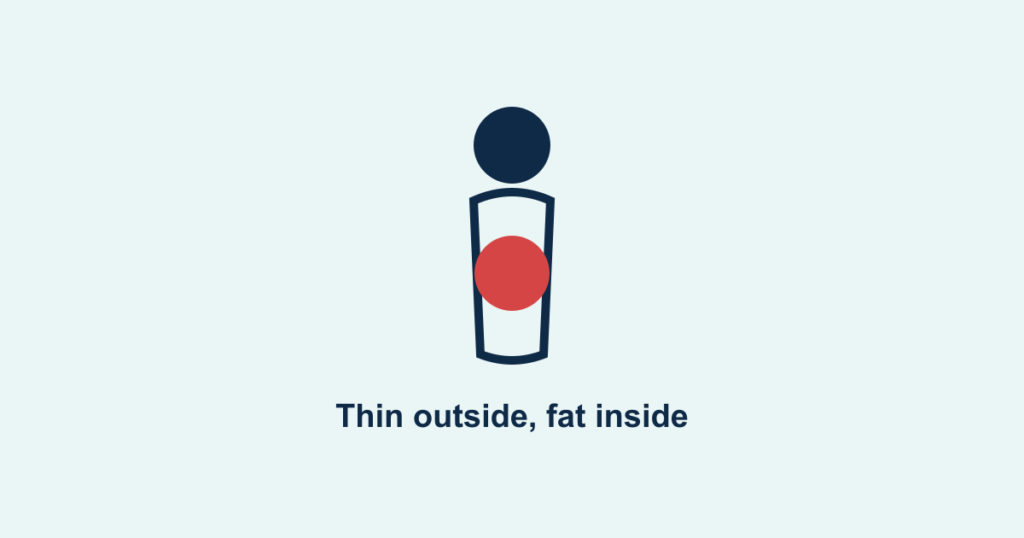
The term describes people whose BMI falls in the healthy range — 18.5 to 24.9 — but who carry a high proportion of body fat, particularly visceral fat around the organs. It is sometimes called metabolically obese normal weight, or, less kindly, “skinny fat”.
The condition is not rare. Our own analysis of NHANES 2021–2023 found that 47% of U.S. adults with a healthy BMI had a waist-to-height ratio of 0.5 or above — roughly 28.7 million people (the full analysis).
One caveat we would rather state than bury: that 0.5 threshold is a deliberately sensitive screening cut-off, and it flags a large share of the whole population. It identifies a risk gradient rather than diagnosing a condition.
Why visceral fat is the part that matters
Fat under the skin — subcutaneous fat, the kind you can pinch — is largely inert metabolically. Visceral fat, packed around the liver, pancreas and intestines, is not.
It behaves like an active organ. It releases free fatty acids directly into the portal circulation feeding the liver, which drives hepatic insulin resistance. It secretes inflammatory signalling molecules. And it is associated with fatty liver, high triglycerides, low HDL and raised blood pressure — the cluster that defines metabolic syndrome.
Two people at the same weight and height can have very different amounts of it. That is the entire problem with using BMI alone.
Who is most likely to have it
People who are sedentary but naturally lean. Low muscle mass plus low activity can leave body fat percentage high even when total weight is unremarkable.
People who have lost weight through severe restriction without resistance training, and lost muscle along with fat.
Older adults. Muscle declines and fat redistributes toward the abdomen with age, often at stable weight (what changes after 50). Our data showed the pattern in 22.5% of healthy-BMI adults aged 20–39, rising to 75.5% at 60 and over.
Women after menopause, where falling oestrogen shifts fat storage toward the abdomen.
People of South and East Asian ancestry, in whom metabolic risk appears at lower BMI and lower waist thresholds than standard cut-offs assume — which means standard screening under-detects it in these groups.
How to check
The most useful measure requires only a tape measure. Waist-to-height ratio: divide your waist by your height in the same units, and under 0.5 is the common target (our calculator).
Measure at the top of your hip bones, at the end of a normal exhale, tape snug but not compressing — not at the narrowest point, and not holding your breath.
Beyond the tape, the blood tests that matter are a fasting glucose or A1C, a lipid panel — where high triglycerides with low HDL is the characteristic signature (why triglycerides matter) — and blood pressure. Those four, plus your waist, are the five criteria of metabolic syndrome.
DEXA and bioimpedance scales exist. DEXA is accurate and rarely necessary; consumer bioimpedance scales are unreliable enough that the trend matters more than any reading.
What to do about it
The answer is unusual in that it is not primarily about losing weight — there may not be much excess weight to lose. It is about changing composition.
Resistance training is the priority, not cardio. Building muscle improves glucose disposal directly and is the main lever when weight itself is not the problem.
Enough protein to support that muscle (how much).
Reduce refined carbohydrate and liquid sugar, which drive both visceral fat and triglycerides (what to cut).
Move throughout the day, not only in sessions, and walk after meals.
Sleep and alcohol both affect visceral fat accumulation directly.
The encouraging part: visceral fat is more metabolically active than other fat and tends to respond early to these changes, which is why waist often improves before the scale moves at all (what works).
When to see a doctor
Ask for a fasting glucose or A1C, a lipid panel and a blood pressure check if your waist-to-height ratio is 0.5 or above — particularly if you have a family history of type 2 diabetes or early heart disease. Mention the finding explicitly, because a normal BMI can otherwise close the conversation before those tests are ordered.
The honest bottom line
A normal BMI is weaker reassurance than most people take it to be, and nearly half of healthy-BMI American adults have an elevated waist-to-height ratio. What matters is where the fat sits and how much muscle you have, and a tape measure detects that better than a scale. The response is resistance training and protein rather than weight loss — and visceral fat, being the most active kind, tends to shift first.
The A1C is the test to ask for — and here is how to read it.
Frequently asked questions
What is normal-weight obesity?
It describes people who have a normal body mass index (BMI) but a high proportion of body fat, especially visceral fat around the organs, which raises cardiometabolic risk despite a 'healthy' weight.
Can you be skinny and still unhealthy?
Yes. Someone thin on the outside can carry excess visceral fat internally — sometimes called 'skinny fat' — which is linked to insulin resistance, high triglycerides, and heart risk.
How do I reduce visceral fat?
Regular exercise (especially combined aerobic and strength training), building muscle, and improving diet quality can shrink visceral fat, often even without a large change on the scale.