📚 Part of our Weight Loss Guide — an evidence-based guide.
Abdominal fat gets more attention than any other kind, and for once the attention is justified — not for cosmetic reasons but metabolic ones. It is also the target of more false promises than almost anything in health. Here is what actually reduces it, what does nothing, and why the tape measure beats the mirror.
🧮 Try our free calculator — waist-to-height ratio calculator. The measurement that predicts risk better than the scale.
Two kinds of belly fat, and only one is the problem
Subcutaneous fat sits just under the skin — the part you can pinch. It is largely inert metabolically.
Visceral fat sits deeper, wrapped around the liver, pancreas and intestines. It is metabolically active in a way subcutaneous fat is not: it releases free fatty acids and inflammatory signals directly into the circulation feeding the liver, driving insulin resistance, raising triglycerides and blood pressure, and lowering HDL.
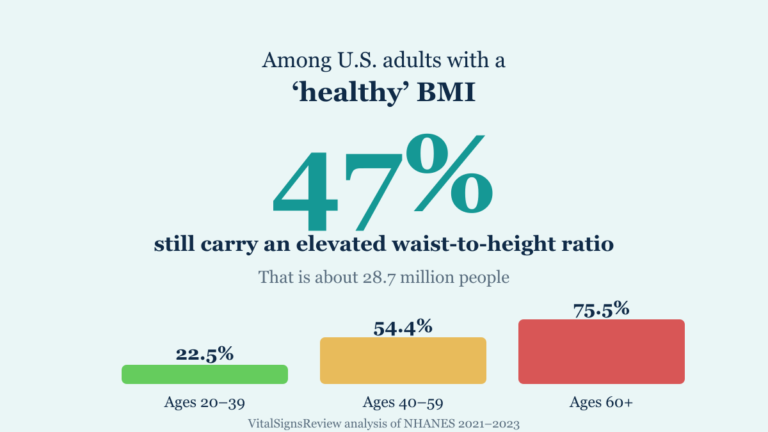
This is why a firm, protruding abdomen can be more concerning than a softer one, and why you can carry visceral fat at a perfectly ordinary weight (normal-weight obesity). Visceral fat is also one of the five criteria in metabolic syndrome.
Spot reduction does not work
This needs stating plainly because the entire ab-exercise industry depends on it not being said. You cannot choose where fat comes off. Crunches strengthen abdominal muscles; they do not remove the fat covering them. Studies training one body region specifically have consistently failed to show localized fat loss.
Fat is mobilized from the whole body according to a distribution largely set by genetics, sex and hormones. Where you lose it first is not up to you.
The good news about visceral fat
Here is the compensation for that: visceral fat tends to be more responsive to an energy deficit than subcutaneous fat, not less. It is metabolically active, which means it is readily mobilized. People losing weight frequently reduce visceral fat proportionally faster than total body fat, which is why waist circumference often improves ahead of the scale.
So the answer to “how do I lose belly fat” is genuinely “lose fat” — and the belly responds well. The protocol is in the evidence-based weight loss guide, with the starting arithmetic in how many calories to eat.
What actually moves it
A modest energy deficit driven mostly by food. Roughly 300 to 500 calories a day. This is the engine.
Protein and fiber to make that deficit survivable and to protect muscle (the research). Soluble fiber has specific associations with lower visceral fat (why).
Strength training, which determines whether what you lose is fat or fat plus muscle (why muscle decides). Combined with cardio it outperforms either alone for visceral fat specifically.
Cutting liquid calories. Sugar-sweetened drinks are among the more consistent dietary correlates of visceral fat, and they produce almost no fullness in exchange.
Alcohol reduction. The “beer belly” stereotype has a real basis: alcohol supplies dense calories, is associated with abdominal fat distribution specifically, and raises triglycerides.
Sleep. Short sleep is independently associated with abdominal fat and drives appetite in the wrong direction (the study).
Daily movement beyond formal exercise, which adds up more than most people expect (NEAT).
The cortisol question, honestly
Cortisol does promote abdominal fat storage, and the phrase “cortisol belly” has a real mechanism behind it. But for the overwhelming majority of people, abdominal fat reflects energy balance, genetics and age — not a cortisol disorder. Dramatic cortisol-driven fat redistribution is a feature of Cushing’s syndrome, which is rare and presents quite differently.
Managing stress is worthwhile and helps indirectly, largely through sleep and eating behavior. Buying a supplement to “block cortisol” is not (what actually works).
Why it gets harder with age — and after menopause
Fat distribution shifts with age even at stable weight, partly through muscle loss and partly through hormonal change (what changes).
In women, the menopausal transition brings a genuine redistribution: falling estrogen shifts fat storage from hips and thighs toward the abdomen, which can increase waist size even when weight does not change. This is real physiology, not a failure of effort, and resistance training plus adequate protein is the most effective counter.
What does nothing
Ab exercises for fat loss. Useful for strength and posture. Useless for removing the fat on top.
Waist trainers, belts and creams. They compress tissue temporarily and remove no fat.
“Belly fat burning” supplements and detox teas. No credible evidence.
Fasted cardio. Changes which fuel you burn during the session, not total fat lost.
Metabolism boosters. What genuinely changes energy expenditure is muscle and daily movement (what works).
Measure the right thing
Waist circumference tracks visceral fat far better than the scale does, and it predicts health outcomes better too (why).
Measure at the top of your hip bones, at the end of a normal exhale, tape snug but not compressing — not at the narrowest point, and not holding your breath. Risk thresholds commonly used are above 40 inches (102 cm) for men and 35 inches (88 cm) for women, with lower cutoffs for people of South and East Asian ancestry.
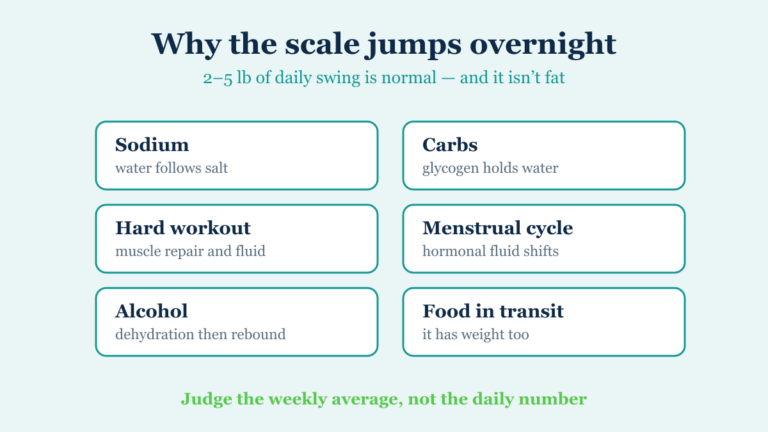
Take it monthly under identical conditions. It often improves while the scale sits still — which is exactly what you want, and exactly what the scale cannot show you (why weight fluctuates).
When to see a doctor
Get checked if your waist exceeds those thresholds, particularly alongside high blood pressure, high triglycerides, low HDL or elevated fasting glucose — that combination is metabolic syndrome and deserves a full panel. See a doctor promptly for rapid abdominal enlargement without weight gain elsewhere, which can indicate fluid accumulation rather than fat, and for abdominal weight gain accompanied by purple stretch marks, easy bruising, muscle weakness and a rounded face, which warrants evaluation for Cushing’s syndrome.
The honest bottom line
You cannot target belly fat, and anyone selling you a way to do it is selling you something. What you can do is create a modest deficit, keep protein and fiber high, lift weights, cut liquid calories and alcohol, sleep enough, and move throughout the day — and visceral fat, being the most metabolically active kind, tends to respond earlier than the rest. Track your waist monthly rather than your abs in the mirror, because the number that predicts your health is the one you measure with a tape.
Frequently asked questions
Can you target belly fat with exercise like crunches?
No. Spot reduction is a myth — crunches strengthen abdominal muscles but don't burn the fat over them. Belly fat shrinks as part of overall fat loss.
What actually reduces belly fat?
An overall calorie deficit through better diet, plus regular exercise (both cardio and strength), enough protein, good sleep, and less alcohol and refined carbohydrate. Belly fat is often the first to respond.
Why is belly fat dangerous?
The deep 'visceral' fat around your organs is metabolically active and inflammatory, raising the risk of heart disease, type 2 diabetes, and high blood pressure.