📚 Part of our Sleep & Stress Guide — an evidence-based guide.
Cortisol has become the internet’s favorite villain. It is blamed for stubborn belly fat, exhaustion, poor sleep, and a condition called adrenal fatigue, and an entire product category now exists to lower it. Some of this is grounded in real physiology. A great deal of it is not, and separating the two is genuinely useful — because the things that actually regulate cortisol are free, and the things being sold to you mostly are not.
What cortisol is for
Cortisol is not a toxin. It is an essential hormone produced by your adrenal glands, and you would die without it. It mobilizes glucose for energy, regulates blood pressure, modulates immune function and inflammation, and helps you wake up.
It follows a strong daily rhythm. Levels are lowest around midnight, rise steeply in the early hours, and peak roughly 30 to 45 minutes after you wake — the cortisol awakening response, which is what gets you out of bed. Levels then decline across the day.
That rhythm matters more than the absolute number. A healthy cortisol profile is not a low one; it is one that rises and falls at the right times.
What genuinely raises it
Chronic psychological stress, particularly the kind involving low control and no clear endpoint. Sleep deprivation and irregular sleep schedules. Heavy alcohol use. Training hard without adequate recovery. Chronic illness, pain and inflammation. Shift work, which attacks the rhythm itself rather than the amount.
Notice what is not on that list: eating carbohydrates, drinking a normal amount of coffee, or the ordinary stresses of a busy week. Cortisol responding to a stressor is the system working, not breaking.
“Adrenal fatigue” is not a diagnosis
This needs saying plainly, because a large industry depends on it not being said. Adrenal fatigue is not a recognized medical condition. The claim is that prolonged stress exhausts the adrenal glands so they can no longer produce enough cortisol, causing fatigue, brain fog and low mood. Systematic reviews of the evidence have not supported it, and endocrinology societies do not recognize it as a diagnosis.
The symptoms are real — people who receive this label are genuinely unwell. The problem is that the label sends them toward supplements instead of toward the actual cause, which is often poor sleep, depression, anemia, thyroid disease, sleep apnea or an unmanaged stressor. The systematic way to work through that is in why am I always tired.
Adrenal insufficiency, by contrast, is a real and serious disease — but it is uncommon, has specific features, and is diagnosed with specific testing rather than a symptom quiz.
What actually lowers cortisol
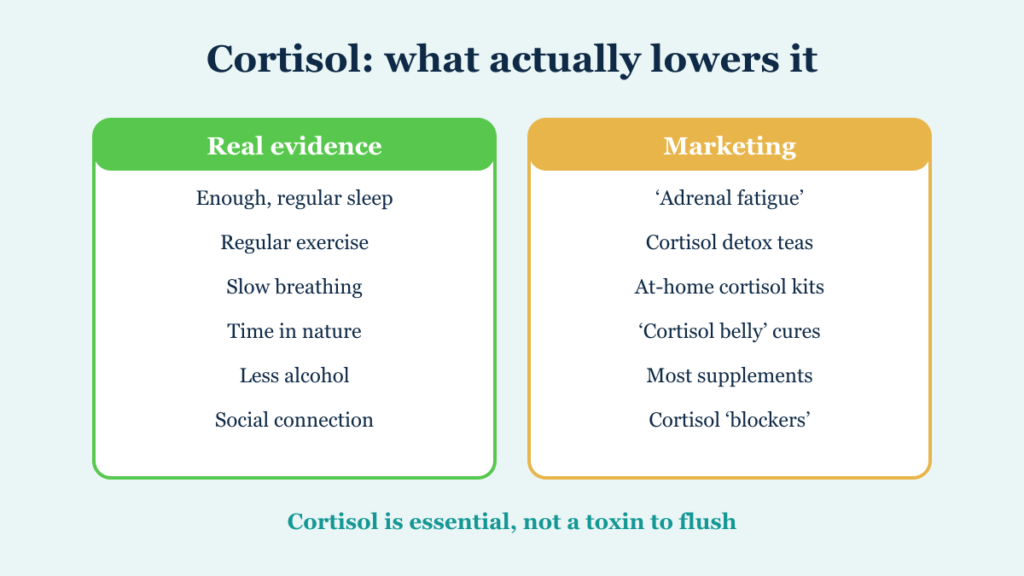
Sleep, in both amount and regularity. This is the highest-yield intervention available, and sleep restriction reliably disrupts the cortisol rhythm. A fixed wake time is the anchor — regularity matters at least as much as duration (the research), and morning light reinforces the rhythm the hormone is supposed to follow (how it works).
Regular exercise. This is counterintuitive: a hard session raises cortisol acutely. But regular training improves how well the whole stress-response system is regulated over time, meaning smaller spikes and faster recovery. The exception is overtraining without recovery, which does the opposite.
Slow breathing. Deliberately slowing your breath shifts autonomic balance and has measurable cardiovascular effects (the science). A brief structured breathing practice outperformed mindfulness meditation for mood and physiological arousal in a controlled trial — cyclic sighing.
Time in nature. Green space exposure measurably reduces stress markers, and the dose required is modest (a walk in the green). Music does real work here as well.
Less alcohol. Alcohol raises cortisol and fragments the second half of the night, which raises it further the next day.
Social connection. Among the most consistently protective factors in stress research, and the one most often left off lists like this because nothing can be sold alongside it.
On “cortisol belly”
There is a real mechanism underneath this phrase: cortisol does promote fat storage in the abdomen, and visceral fat is the metabolically harmful kind (why it matters). Sustained high cortisol also drives appetite toward calorie-dense food.
What is not true is that abdominal fat is usually caused by cortisol, or that lowering cortisol is how you lose it. For the overwhelming majority of people, abdominal fat reflects overall energy balance, genetics and age — and it responds to the ordinary levers in how to lose belly fat. Dramatic cortisol-driven fat redistribution is a feature of Cushing’s syndrome, which is rare and looks quite different.
Supplements and at-home tests
Ashwagandha is the one with the most credible research: several randomized trials report reductions in perceived stress and cortisol. Take it as genuinely promising and not yet settled — the trials are small, short, use different preparations and doses, and are frequently funded by manufacturers. It is not a substitute for sleep, and it interacts with thyroid medication and immunosuppressants.
Most other “cortisol-lowering” products — detox teas, cortisol blockers, adrenal support blends — have little behind them.
On testing: direct-to-consumer saliva or urine cortisol kits are marketed for stress, but cortisol varies enormously across the day and between days, so a single measurement tells you very little. Legitimate cortisol testing exists to diagnose Cushing’s syndrome or adrenal insufficiency, uses specific protocols, and is interpreted by a clinician. Testing to find out whether you are “stressed” is answering a question you can already answer.
When to see a doctor
See a doctor for possible Cushing’s syndrome if you have weight gain concentrated in the face and trunk with thin arms and legs, wide purple stretch marks, easy bruising, muscle weakness, and new high blood pressure or blood sugar. See a doctor for possible adrenal insufficiency if you have persistent fatigue with weight loss, low blood pressure, dizziness on standing, salt craving, or darkening of the skin.
Also worth a visit: fatigue lasting more than a few weeks, or stress severe enough to affect your sleep, work or relationships. Both are treatable, and neither is best addressed from a supplement aisle.
The honest bottom line
Cortisol is a necessary hormone with a daily rhythm, and the goal is a healthy rhythm rather than a low number. What regulates it is well established and unexciting: consistent sleep, regular exercise without overtraining, slow breathing, time outdoors, less alcohol, and reducing the stressors you can actually reduce. Adrenal fatigue is not a recognized diagnosis, at-home cortisol tests answer little, and the supplement with the best case for it still rests on small, short, largely industry-funded trials. If your symptoms are severe or specific, the answer is a doctor and a real test — not a cortisol detox.
Frequently asked questions
What are the symptoms of high cortisol?
Genuinely high cortisol from Cushing's syndrome causes weight gain in the face and trunk with thin limbs, wide purple stretch marks, easy bruising, muscle weakness, and new high blood pressure or blood sugar. Ordinary stress does not produce that pattern.
What is the fastest way to lower cortisol?
There is no instant fix, but slow breathing produces measurable effects within minutes, and consistent sleep is the highest-yield change over days to weeks. Regular exercise, time outdoors and reducing alcohol all improve cortisol regulation.
Is adrenal fatigue real?
Adrenal fatigue is not a recognized medical diagnosis, and systematic reviews have not found evidence supporting it. The symptoms are real, but they are usually explained by poor sleep, depression, anemia, thyroid disease or sleep apnea, which are all testable.