📚 Part of our Sleep & Stress Guide — an evidence-based guide.
Persistent tiredness is one of the most common reasons people see a doctor, and one of the most frustrating, because “I’m always tired” can point at a dozen different things. The good news is that the possibilities sort into a fairly short list, and most of them are either fixable at home or identifiable with a routine blood test.
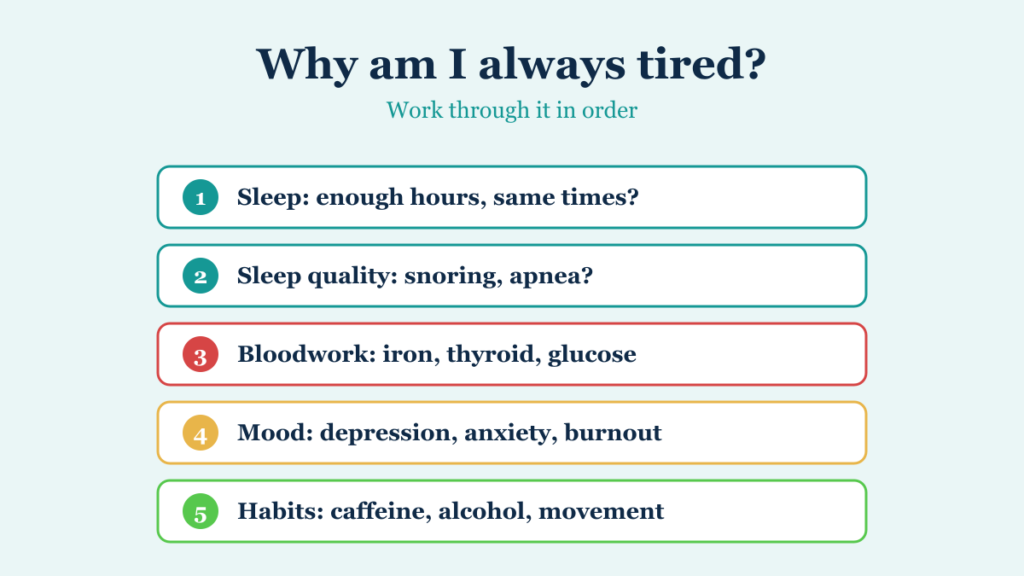
The useful approach is to work through them in order, because the common causes really are far more common than the exotic ones. Here is that order.
First: are you actually sleeping enough — and regularly?
Start with the obvious, because it is the answer more often than anything else. Most adults need seven to nine hours, and the group who genuinely thrive on less is much smaller than the group who believe they belong to it (the evidence on duration).
But duration alone is not the whole story. Regularity — going to bed and especially waking at consistent times — predicts health outcomes at least as strongly as total hours (the research). A person averaging eight hours across wildly varying schedules can feel worse than someone getting a consistent seven.
Before investigating anything else, spend two weeks with a fixed wake time and a realistic bedtime. A surprising share of chronic fatigue resolves right here.
Second: is your sleep quality bad even when the hours are fine?
If you are in bed for eight hours and still exhausted, the question becomes what is happening during those hours.
Sleep apnea is the big one, and it is both common and badly underdiagnosed. The pattern is loud snoring, gasping or choking, and waking unrefreshed despite adequate time in bed — often with morning headaches and daytime sleepiness severe enough to affect driving. If any of that is familiar, this deserves testing rather than another supplement: the warning signs.
Alcohol is the other frequent culprit, and it is deceptive: it helps you fall asleep and then fragments the second half of the night. Late caffeine does its damage more quietly, since its half-life is longer than most people assume (how late is too late). A room that is too warm also blocks the temperature drop sleep requires (the science).
If you are waking repeatedly, why do you wake up in the middle of the night works through the usual causes. If falling asleep is the problem and it has persisted for weeks, read what causes insomnia — the first-line treatment for chronic insomnia is CBT-I, not a sleeping pill.
Third: get bloodwork
If sleep genuinely is not the problem, this is where the answer usually lives. A handful of ordinary tests cover most of it.
Iron deficiency and anemia. One of the most common and most missed causes of fatigue, particularly in menstruating women. Iron can be low enough to cause symptoms before anemia appears on a standard blood count, so ferritin matters, not just hemoglobin.
Thyroid function. An underactive thyroid produces fatigue alongside cold intolerance, weight gain, dry skin, and constipation. A simple TSH test screens for it.
Blood glucose and A1C. Both undiagnosed diabetes and unstable blood sugar cause fatigue, and glucose swings from meals produce the classic afternoon crash (what the numbers mean).
Vitamin B12 and vitamin D. Worth checking — but with an honest caveat. Correcting a genuine deficiency helps. Supplementing when you are not deficient does very little, despite how these are marketed (who actually benefits).
Kidney and liver function and a basic inflammatory marker are usually included as well. This whole panel is routine and inexpensive.
Fourth: mood, and the kind of tiredness that sleep does not fix
Depression very commonly presents as fatigue rather than sadness, particularly in people who would not describe themselves as depressed. Anxiety is exhausting in a different way — sustained arousal burns energy and wrecks sleep quality simultaneously.
Burnout has its own signature: tiredness that does not improve with a weekend off, accompanied by cynicism about work and a sense of reduced effectiveness. It responds to changes in demand and control, not to more sleep.
The distinguishing question is whether rest restores you. Fatigue that improves with a good night’s sleep is usually physiological. Fatigue that does not is more often mood, stress, or an underlying medical condition.
Fifth: the habits that quietly drain you
Being sedentary is tiring. This is counterintuitive and well established — regular activity reduces fatigue rather than adding to it, including in people who are already exhausted. If you have been inactive, the first sessions will feel worse before they feel better, and the effect on energy usually shows up within a few weeks.
Caffeine deserves a specific mention: heavy use masks a sleep debt without repaying it, and the resulting cycle of stimulation and crash is itself fatiguing. Chronic stress does the same through cortisol (the mechanism). And check your medication list — antihistamines, beta blockers, some antidepressants, and blood pressure medications all list fatigue as a common effect.
What about long COVID and chronic fatigue syndrome?
Post-viral fatigue is real and can persist for months after an infection. Myalgic encephalomyelitis / chronic fatigue syndrome (ME/CFS) is a distinct diagnosis with a defining feature worth knowing: post-exertional malaise, meaning symptoms get markedly worse for a day or more after exertion that would previously have been trivial.
That detail matters practically, because the standard advice to exercise more can make ME/CFS worse. If your fatigue reliably worsens after activity rather than improving, say so explicitly to your doctor — it changes the management.
When to see a doctor sooner rather than later
Book an appointment if fatigue has lasted more than a few weeks without an obvious cause, or if it comes with any of: unexplained weight loss or gain, fever or night sweats, shortness of breath, chest pain, swelling, unusual bruising or bleeding, a lump, severe headaches, or fatigue severe enough to make driving unsafe. Also raise it promptly if you have thoughts of self-harm — fatigue and depression travel together often enough that it is always worth asking about directly.
The honest bottom line
Work the list in order. Two weeks of adequate, regular sleep resolves a large share of chronic tiredness on its own. If it does not, the next question is whether your sleep is being sabotaged — by apnea, alcohol, caffeine, or a warm bedroom. If sleep is genuinely fine, get bloodwork; iron and thyroid alone account for a great many cases. And if everything comes back normal and you still feel exhausted, that is not the end of the investigation — mood, burnout, and post-viral fatigue are real diagnoses, not a verdict of “nothing is wrong.”
If a CPAP mask is the barrier, a pill for sleep apnea is now under FDA review.
One cause is routinely missed because the standard blood count cannot detect it: iron deficiency without anaemia.
Frequently asked questions
What blood tests should I ask for if I'm always tired?
A complete blood count with ferritin to check iron stores, a TSH for thyroid function, fasting glucose and A1C for blood sugar, plus vitamin B12 and vitamin D. Kidney and liver function are usually included too. This panel is routine and identifies most medical causes.
Why am I tired even after 8 hours of sleep?
Usually because sleep quality, not quantity, is the problem. Sleep apnea is the most important cause to rule out, especially with loud snoring or gasping. Alcohol, late caffeine, an irregular schedule, and a too-warm bedroom all fragment sleep as well.
When should I see a doctor about fatigue?
If it has lasted more than a few weeks without an obvious cause, or comes with unexplained weight change, fever or night sweats, shortness of breath, chest pain, unusual bruising, or severe headaches. Also see a doctor if tiredness makes driving unsafe.