📚 Part of our Heart Health Guide — an evidence-based guide.
For thirty years eggs were the villain of the American breakfast table, and then, fairly abruptly, they were not. If you find that confusing, it is because the underlying science genuinely shifted — and because it has not fully settled even now. Here is what is actually established, what is still contested, and what it means for your own breakfast.
Where the fear came from
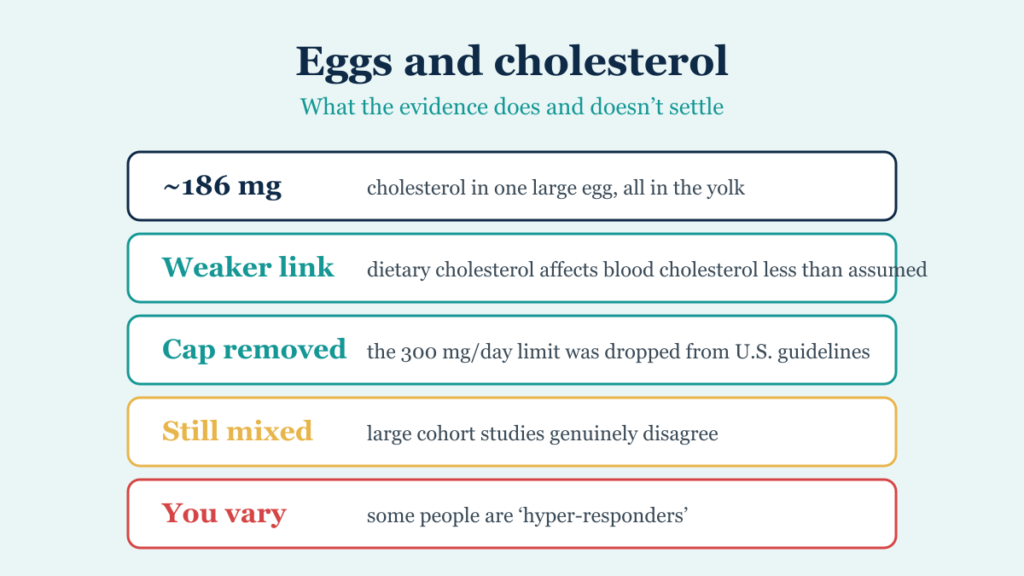
One large egg contains roughly 186 mg of cholesterol, essentially all of it in the yolk. For decades, U.S. dietary guidance advised keeping dietary cholesterol under 300 mg a day, which made a two-egg breakfast look reckless.
The logic was intuitive: cholesterol in food raises cholesterol in blood, and cholesterol in blood drives heart disease. The second half of that chain is solid. The first half turned out to be much weaker than anyone expected.
What changed
For most people, the cholesterol you eat has a surprisingly modest effect on the cholesterol in your blood. Your liver produces most of your circulating cholesterol and compensates when you consume more — it simply makes less. Saturated fat has a substantially larger effect on LDL than dietary cholesterol does.
Recognizing this, the 2015–2020 Dietary Guidelines for Americans dropped the explicit 300 mg daily cap, while still advising people to keep dietary cholesterol as low as practicable within a healthy eating pattern. That nuance was widely reported as “eggs are back,” which overstated it.
Why the debate did not end there
Here is the part that usually gets left out. Removing the cap was a statement about dietary cholesterol in general, not a verdict on eggs specifically — and the research on eggs has continued to disagree with itself.
Some large pooled analyses of U.S. cohort studies have found that each additional half-egg per day is associated with a small increase in cardiovascular disease and all-cause mortality. Other large cohorts, including several outside the United States, have found no meaningful association, and some have found none even at an egg a day.
A major reason for the disagreement is what statisticians call confounding by dietary pattern. In American data, eggs travel with bacon, sausage, butter, and white toast. In other populations they travel with vegetables. Separating the egg from its company is genuinely difficult, and different analytical choices produce different answers — which is exactly what we see in the literature.
Our read: the honest summary is that eggs are not the hazard they were once thought to be, and that the residual uncertainty is real rather than manufactured. Anyone who tells you this question is fully settled in either direction is ahead of the evidence.
Some people really do respond differently
Population averages hide a genuine biological split. Researchers describe a minority of people as hyper-responders: their blood cholesterol rises noticeably in response to dietary cholesterol, while most people barely move. This variation is partly genetic.
The practical implication is unusually clean. If you eat eggs regularly, you can simply find out which group you are in — have a lipid panel, change your egg intake meaningfully for two to three months, and repeat the panel. That personal answer is more useful than any population average.
If you have type 2 diabetes
This is the one group where caution is more clearly warranted. Several analyses have found stronger associations between egg intake and cardiovascular risk in people with type 2 diabetes than in people without it. The mechanism is not fully established and the evidence is not unanimous, but it is consistent enough that most guidance suggests a more moderate intake in this group and an individual conversation with your doctor.
If that applies to you, the wider context matters too — see metabolic syndrome and insulin resistance.
What you eat with the egg matters more than the egg
This is the most useful sentence in the whole debate. Two eggs scrambled in a little olive oil with spinach and a slice of whole-grain toast is a meaningfully different meal from two eggs fried in butter alongside sausage and white bread — and the difference is driven mostly by the saturated fat and refined starch, not the eggs.
Eggs are also a genuinely useful source of protein at the meal where most people get the least of it, which has real downstream effects on appetite — see why a high-protein breakfast curbs hunger and how much protein you actually need.
What actually moves your cholesterol
If your goal is a better lipid panel, eggs are far down the list of levers. What moves LDL meaningfully: reducing saturated fat, increasing soluble fiber, losing excess weight, and increasing physical activity. The full protocol is in how to lower cholesterol naturally.
It also helps to know which numbers matter. Total cholesterol is the least informative of them — cholesterol numbers explained sorts out LDL, HDL and triglycerides, and there is one inherited marker most people are never tested for: Lp(a).
So how many eggs is reasonable?
For a healthy adult with normal cholesterol, roughly one egg a day fits comfortably within an otherwise sound eating pattern, and most guidance now lands somewhere in that neighborhood. Egg whites contain no cholesterol at all, so mixing whole eggs with whites is a simple way to keep the protein while reducing the cholesterol load.
Be more conservative if you have high LDL, established cardiovascular disease, or type 2 diabetes — and in those cases, make it a conversation with your doctor rather than a rule you set yourself.
When to talk to a doctor
Get a lipid panel if you have never had one, or if it has been more than a few years. Talk to your doctor before making eggs a daily habit if you have known heart disease, high LDL, familial hypercholesterolemia, or type 2 diabetes. And if you have a family history of early heart disease, ask specifically about Lp(a) — it is inherited, it is not on a standard panel, and it only needs to be measured once.
The honest bottom line
Eggs are not the cardiovascular threat they were labeled as in the 1980s, and dietary cholesterol matters less than saturated fat for most people. But the research on eggs specifically remains genuinely mixed, individual responses vary, and people with type 2 diabetes may warrant more caution. For most healthy adults, about one a day is reasonable — and what you cook them in and serve beside them will affect your heart more than the eggs themselves.
Frequently asked questions
How many eggs a day is safe?
For a healthy adult with normal cholesterol, roughly one a day fits comfortably within an otherwise healthy eating pattern. Be more conservative if you have high LDL, established heart disease, or type 2 diabetes, and discuss it with your doctor.
Do eggs raise your cholesterol?
Less than was once believed. Your liver compensates for dietary cholesterol by producing less of its own, and saturated fat has a much larger effect on LDL. A minority of people, called hyper-responders, do see a noticeable rise.
Are egg whites better than whole eggs?
Egg whites contain the protein and no cholesterol, since all of it is in the yolk. Mixing whole eggs with extra whites keeps the protein while reducing the cholesterol load, which is a practical option if your LDL is high.