📚 Part of our Blood Sugar Guide — an evidence-based guide.
Few questions in nutrition produce more confident, contradictory answers than this one. One camp says fruit is nature’s candy and a fast route to a glucose spike. The other says fruit is health food and the sugar in it does not count. Both are oversimplifications, and the real answer is more useful than either.
Fruit does contain sugar. It also arrives wrapped in fiber, water, and volume — and that packaging changes almost everything about how your body handles it. Here is what the evidence actually shows.
What is actually in a piece of fruit
The sugar in fruit is mostly fructose and glucose, and chemically it is no different from the sugar in a cookie. That fact is the entire basis of the “sugar is sugar” argument, and taken alone it is misleading.
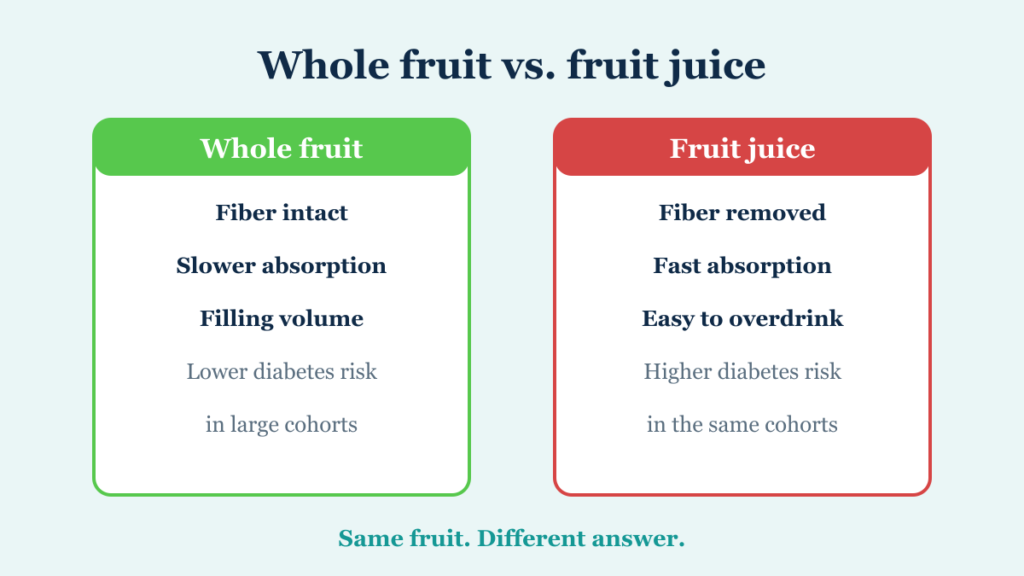
What differs is the delivery. A medium apple contains roughly 19 grams of sugar alongside about 4 grams of fiber and a great deal of water, packed into a structure your digestive system has to physically break down. That structure slows the release of sugar into your bloodstream, and the volume triggers fullness long before you have eaten very much of it.
Compare that to the same sugar in liquid form with the fiber removed and the volume reduced, and you have a fundamentally different metabolic event — even though a lab analysis of the sugar molecules would look similar.
What the long-term evidence shows
This is where the picture gets genuinely interesting. In large cohort studies following hundreds of thousands of people over decades, higher intake of whole fruit is associated with a lower risk of developing type 2 diabetes. In the very same studies, higher intake of fruit juice is associated with a higher risk.
The effect is not uniform across fruits. Blueberries, grapes, and apples and pears have shown the strongest inverse associations with diabetes risk — likely reflecting some combination of fiber content, polyphenols, and how quickly the sugar is released.
One honest caveat: these are observational studies. People who eat more whole fruit tend to differ in many other ways — they smoke less, exercise more, and eat better overall. Researchers adjust for what they can measure, but adjustment is never complete, so this evidence shows a consistent pattern rather than proof of cause. What makes it persuasive is that the juice finding points the opposite direction within the same populations, which is hard to explain by healthy-user bias alone.
Which fruits raise blood sugar the most
Glycemic response varies more by form than by fruit, but there are real differences.
Lowest impact: berries — strawberries, blueberries, raspberries, blackberries. High fiber, high water, relatively modest sugar per serving. Cherries, apples, pears, and citrus also sit at the gentler end.
Higher impact: very ripe bananas, mango, pineapple, and grapes deliver more sugar per bite with less fiber to slow it. Ripeness matters within a single fruit — a spotted banana produces a noticeably larger glucose response than a slightly green one, because the starch has converted to sugar.
Concentrated: dried fruit. Removing the water leaves the sugar behind in a much smaller package. A handful of raisins is a great deal of grape. It is not forbidden, but portion awareness matters in a way it does not with fresh fruit, where volume does the limiting for you.
Juice and smoothies are not the same thing
Juicing strips the fiber and eliminates the volume. It takes several oranges to make one glass of orange juice, and no one would eat several oranges in two minutes — but the juice goes down effortlessly. That is why juice behaves more like a sugar-sweetened beverage than like fruit, and why it tracks with sugary drinks in the cohort data.
Smoothies sit in between. Blending disrupts the fiber structure but does not remove the fiber, so the glucose response is generally intermediate — higher than whole fruit, lower than juice. The bigger practical risk with smoothies is composition: a smoothie made of four fruits plus juice plus honey is a very large sugar load in one glass, regardless of the fiber.
The general principle applies here too — see why carb quality matters, not just quantity.
How to eat fruit so it barely registers
Three practical adjustments do most of the work.
Eat it whole rather than drinking it. This single change accounts for most of the difference between the two columns of evidence above.
Pair it with protein or fat. An apple with peanut butter, berries with Greek yogurt, or fruit at the end of a mixed meal produces a much flatter glucose curve than fruit alone on an empty stomach. This is the same mechanism behind eating fiber and protein before carbohydrate.
Move afterward. A short walk in the window when glucose is peaking blunts the rise substantially — see the trial on post-meal walking.
If you have prediabetes or diabetes
Fruit is not off-limits, and treating it as forbidden is a common and counterproductive mistake — it removes fiber, potassium, and polyphenols from a diet that usually needs more of all three.
What changes is precision. Portion matters more, pairing matters more, and form matters most of all: juice and dried fruit deserve real caution while whole fruit generally does not. If you use a glucose meter or a monitor, you have an advantage here, because individual responses to specific fruits vary considerably and you can simply test yours. Background on interpreting those numbers is in what is a normal blood sugar level, and on the wider strategy in can you reverse prediabetes.
For the foods that genuinely deserve limiting, see foods to avoid with high blood sugar — whole fruit is not on that list.
What we do not know
Two honest gaps. First, most of the long-term evidence is observational, so the size of the benefit from whole fruit is uncertain even though the direction is consistent. Second, individual glucose responses to identical foods vary more than most guidance acknowledges — two people can eat the same banana and produce meaningfully different curves. Population averages are a starting point, not a personal prescription.
When to talk to a doctor
Bring it up if you have diabetes and are unsure how to fit fruit into your medication or insulin timing, if you are seeing unexplained high readings after meals you thought were reasonable, or if you have been told to restrict potassium for kidney disease — several fruits are high in potassium, and that guidance is genuinely individual. Anyone who has never had a fasting glucose or A1C checked should start there rather than with dietary fine-tuning.
The honest bottom line
Whole fruit is not a threat to your blood sugar for most people, and the long-term evidence associates it with lower diabetes risk, not higher. Fruit juice is a different food and behaves like one. The useful distinctions are form, portion, and company: eat it whole, keep dried fruit and juice modest, favor berries and firmer fruits if you are managing glucose, and pair it with protein rather than eating it alone. The advice to avoid fruit because it contains sugar gets the chemistry right and the biology wrong.
Frequently asked questions
Does fruit raise blood sugar?
Whole fruit raises blood sugar modestly, because its fiber, water and physical structure slow how quickly the sugar is absorbed. Fruit juice raises it far more sharply, since the fiber is removed and the volume is much smaller.
Which fruits are lowest in sugar?
Berries such as strawberries, raspberries and blackberries are lowest in sugar per serving and highest in fiber. Cherries, apples, pears and citrus are also relatively gentle. Very ripe bananas, mango, pineapple and grapes deliver more sugar per bite.
Can diabetics eat fruit?
Yes. Whole fruit is generally recommended rather than avoided, since it supplies fiber and potassium. What matters is portion, pairing it with protein or fat, and being cautious with juice and dried fruit, which are far more concentrated.