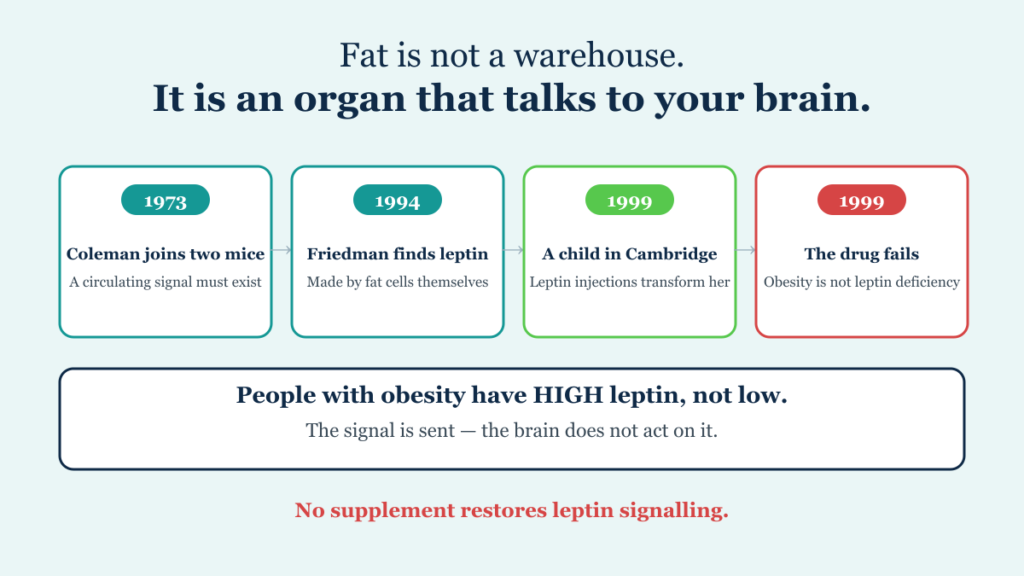
In a windowless animal room in Bar Harbor, Maine, in the late 1960s, a quiet biochemist named Douglas Coleman was doing something that sounds, today, almost unpublishable. He was surgically joining pairs of mice together — a flap of skin opened along each animal’s flank, the two sewn so that their circulatory systems slowly fused and blood passed between them. The technique is called parabiosis. It is grim, and it answered a question that nothing else could.
Coleman had two strains of famously fat mice. One, called ob/ob, ate relentlessly and grew to three times the weight of a normal mouse. The other, db/db, did exactly the same thing. Under a microscope, in a cage, on a scale, they were indistinguishable. Everyone assumed they were the same defect discovered twice.
Then Coleman joined an ob/ob mouse to a normal one. The fat mouse ate less. It lost weight.
Then he joined a db/db mouse to a normal one, and something disturbing happened. The db/db mouse carried on eating and stayed enormous. Its healthy partner stopped eating almost entirely, and starved to death.
The conclusion nobody wanted
Coleman reasoned his way to an answer that ran against everything his field believed. There must be a hormone — a chemical signal made by the body that travels in the blood and tells the brain how much fat is in storage. The ob/ob mouse could not make it, which is why it never felt full, and why a partner’s blood supply rescued it. The db/db mouse made the hormone in enormous quantities but could not hear it, so it kept eating while flooding its unfortunate partner with a starvation signal so powerful that the healthy mouse simply stopped eating.
This was 1973. The prevailing view of obesity at the time was psychological and moral: appetite was behaviour, behaviour was choice, and fat was the accumulated evidence of poor choices. Coleman was proposing that body weight is defended by a hormonal control system, like blood pressure or body temperature — a system that can break.
He could not identify the hormone. The tools did not exist. He spent years being politely ignored, and eventually moved on to other work.
Twenty-one years in the dark
It took until 1994. At Rockefeller University in New York, Jeffrey Friedman’s laboratory spent eight years on a brute-force hunt called positional cloning — narrowing down the region of mouse chromosome 6 that contained the ob gene, base pair by base pair, without knowing what they were looking for.
In December 1994, they published it in Nature. The ob gene coded for a previously unknown hormone, secreted by fat cells themselves. Friedman named it leptin, from the Greek leptos, thin.
Coleman had been right in every particular, including a detail he could not have known: the db gene, cloned shortly afterwards, turned out to code for the leptin receptor. The db/db mouse was deaf to the very signal it was screaming.
The two men shared the Lasker Award in 2010. Coleman died in 2014.
What this actually overturned
Take a moment on this, because the significance is easy to skim past.
Before 1994, fat tissue was understood as inert — a passive warehouse. Calories in excess went into the warehouse; calories in deficit came out. The warehouse did not have opinions.
Leptin proved that fat tissue is an endocrine organ. It manufactures hormones. It talks to the brain. It participates in decisions about hunger, energy expenditure, immune function, reproduction and bone metabolism. An entire field — the study of adipokines, the signalling molecules fat cells release — came into existence essentially overnight.
And the direction of the conversation was the opposite of what anyone expected. Leptin does not exist to stop you overeating. It exists to warn the brain that fat stores are falling. Leptin levels drop when you lose weight, and that drop triggers a defence: hunger rises, energy expenditure falls, thyroid and reproductive hormones shift. Evolution built this system to survive famine, not to prevent abundance.
Which means the fat cells in your body are not a record of your past decisions. They are an organ, currently sending signals, that has a vote on what happens next.
The girl in Cambridge
Three years later came the result that still stops people cold.
At Addenbrooke’s Hospital in Cambridge, England, Sadaf Farooqi and Stephen O’Rahilly were referred a nine-year-old girl who weighed roughly 94 kilograms — over 200 pounds. Her hunger was not ordinary hunger. She would eat anything within reach, wake in the night to look for food, and become distressed when it was withheld. Her family were not overfeeding her. They were exhausted from guarding the kitchen.
She had two mutant copies of the leptin gene. Her body could not produce leptin at all. She was, in her own physiology, permanently starving — her brain receiving the same signal a famine victim’s brain receives, continuously, since birth.
They gave her daily injections of recombinant human leptin.
The results, published in the New England Journal of Medicine in 1999, were among the most dramatic in the history of metabolic medicine. Her food intake collapsed. She lost weight steadily and substantially over the following years. Later work in similar patients showed something more revealing still: brain imaging demonstrated that leptin changed how food was perceived. Images of food stopped lighting up reward circuitry the way they had. It was not that she was resisting temptation better. The temptation had been turned down.
Congenital leptin deficiency is extraordinarily rare — a few dozen families identified worldwide. But it demonstrated, in a human being, that a single hormone deficiency could produce severe obesity and that replacing it could reverse the condition entirely.
Then the drug failed
Here is where a lesser story would end, and where this one gets honest.
The obvious next step was to give leptin to people with common obesity. Amgen had already paid Rockefeller a reported $20 million for the rights. The logic seemed airtight: leptin makes you eat less; give it to people who need to eat less.
The trial, led by Steven Heymsfield and published in JAMA in 1999, tested recombinant leptin in adults with obesity. The result was a modest average weight loss, enormously variable between individuals, at doses requiring large daily injections that frequently caused reactions at the injection site.
It was not a cure. It was not close.
The reason had been sitting in the data the entire time, and it is the single most important fact in this story. When researchers measured leptin in people with obesity, they did not find a deficiency. They found the opposite: leptin levels were high, roughly in proportion to fat mass. More fat, more leptin, exactly as the system was designed to do.
The bodies of people with common obesity were producing the signal correctly. The brain was not responding to it. In the language that emerged — and the language is a description rather than an explanation — they had leptin resistance.
Adding more leptin to a system already saturated with leptin does approximately nothing. It is the biological equivalent of shouting at someone who is not deaf but is not listening.
The honest state of “leptin resistance”
You will see leptin resistance described online with great confidence, usually attached to a protocol for reversing it. That confidence is not warranted, and the gap between the certainty of the marketing and the uncertainty of the literature is worth knowing about.
What is reasonably established: leptin levels track fat mass; people with obesity have high leptin; exogenous leptin has little effect in that setting; and transport of leptin across the blood-brain barrier appears to become less efficient at high concentrations. Hypothalamic inflammation and impairment of intracellular signalling downstream of the receptor have been demonstrated in animal models.
What is not established: exactly which of these mechanisms dominates in humans, whether leptin resistance is a cause of obesity or a consequence of it, and — critically — whether any dietary intervention, supplement or protocol reverses it. No supplement has been shown to restore leptin sensitivity. Nothing sold on that basis has evidence behind it. If you encounter a “leptin reset diet”, you are looking at a real scientific term applied to a product that has never been tested against it.
There is also a live debate about the framing itself. Some researchers argue that “resistance” is the wrong metaphor — that leptin’s system evolved to defend a lower bound against starvation and simply has a weak upper bound, because for most of human history there was no evolutionary pressure to prevent obesity. In that reading, the brain is not failing to hear leptin. It was never designed to act on a surplus.
Where leptin genuinely works
Leptin did not disappear as a medicine. It found the patients it can actually help, and this is a real, if narrow, success.
Metreleptin, a leptin analogue, was approved by the FDA in 2014 for generalised lipodystrophy — a rare condition in which people cannot produce fat tissue. Without fat tissue they cannot produce leptin, and they develop severe insulin resistance, extreme triglyceride elevation, fatty liver and often diabetes that resists ordinary treatment. Leptin replacement can transform these patients.
It also has a role in hypothalamic amenorrhoea, where low body fat and low leptin shut down reproductive function in athletes and in people recovering from eating disorders — a reminder that leptin’s job is telling the brain there is enough fuel to afford reproduction.
The pattern is instructive: a hormone that fails as a treatment for the common condition can be exactly right for the rare one. The lesson is about matching mechanism to patient, not about leptin being a disappointment.
The finding that explains why weight comes back
There is one more chapter, and for most readers it is the practically important one.
Rudolph Leibel and Michael Rosenbaum at Columbia had shown something uncomfortable: when people lose roughly 10% of their body weight and are held there, their energy expenditure falls by more than the loss of tissue predicts. The body becomes measurably more efficient. Muscle does more work per unit of fuel. Thyroid hormones shift, sympathetic nervous system activity falls, and hunger hormones move in the direction of eating more.
This is not a metaphor about metabolism “slowing down”. It is measurable, reproducible, and it persists.
Then they did the experiment that connects everything on this page. They gave weight-reduced participants low-dose leptin — enough to restore leptin to the level it had been at before weight loss.
A large share of those adaptations reversed. Energy expenditure moved back toward baseline. Thyroid levels and autonomic function shifted back. The changes in how the brain responded to food images normalised.
The falling leptin signal was not merely associated with the body’s defence of its former weight. It was substantially driving it.
This is the mechanism underneath an experience millions of people have had and been blamed for. After significant weight loss, you are hungrier than you were before at the same weight, and you burn less. That is not weakness. That is an endocrine organ doing precisely what it evolved to do, reporting a fall in fuel reserves to a brain that treats the report as an emergency (how metabolic adaptation works).
Why GLP-1 drugs succeeded where leptin failed
The obvious question: if the leptin approach collapsed, why do the current obesity drugs work?
Because they are not fighting the same battle. Leptin therapy tried to shout louder down a channel that was already saturated and unresponsive. GLP-1 receptor agonists act through an entirely different pathway — a gut hormone system that is not resistant, using receptors in the brainstem and hypothalamus that respond to pharmacological doses.
They also do not fix the underlying defence. This is why weight regain after stopping is the rule and not the exception: the leptin-driven defence of the higher weight is still there, waiting, unaltered (what GLP-1 drugs do beyond weight).
Interestingly, one of the more promising research directions is combining the two — the theory being that weight loss induced by one drug lowers leptin and triggers the defence, and that restoring leptin during that window might blunt the rebound. It is being investigated. It is not established.
What you should take from this
This story is not a protocol. Nothing here tells you what to eat tomorrow. Its value is in changing the frame you use to interpret your own body, and a wrong frame is expensive.
Body weight is regulated, not merely accumulated. There is a hormonal control system, it defends against loss far more aggressively than against gain, and it operates below the level of conscious decision. When you are hungrier six months after losing 15 kilograms, you are experiencing an endocrine signal, not a character defect.
Fat is an organ, and where it sits determines what it says. Visceral fat around the organs behaves differently from subcutaneous fat, releasing free fatty acids and inflammatory signals straight into the liver’s blood supply. This is why a normal BMI can conceal genuine metabolic risk — and in our own analysis of NHANES data, 47% of US adults with a healthy BMI had an elevated waist-to-height ratio. A tape measure sees something a scale cannot (why this matters).
Defence of a weight is not a life sentence. The adaptations are real and they are also finite — on the order of a few hundred calories a day, not a metabolic prison. People do sustain loss. The system makes it harder, not impossible, and knowing that it is a system rather than a personal failing is what keeps people in the fight rather than out of it.
Anything sold to you as a leptin fix is not one. The one intervention proven to restore leptin signalling is injecting leptin, it works only in specific patients, and it is a prescription medication. There is no supplement version of this.
What does move the system is unglamorous and well evidenced: adequate protein, resistance training that preserves the lean mass which sets your metabolic floor, sleep — short sleep raises ghrelin and lowers leptin within days — and reducing visceral fat specifically, which responds early and disproportionately to movement and reduced refined carbohydrate (what works).
When to see a doctor
See a doctor about severe obesity beginning in early childhood with extreme, unrelenting hunger — rare single-gene causes including leptin and MC4R pathway defects exist, some are now treatable, and genetic testing is available at specialist centres. Also see a doctor for unexplained weight gain with fatigue, cold intolerance or hair changes, which may indicate thyroid disease; for weight gain alongside easy bruising, purple stretch marks and muscle weakness; and for any unintentional weight loss of more than 5% of body weight, which needs investigation rather than celebration.
If you carry excess weight around the middle, ask for an A1C or fasting glucose, a lipid panel and a blood pressure check — a normal BMI does not exclude any of the conditions those tests detect.
The bottom line
Douglas Coleman sewed mice together and worked out, from nothing but who lived and who starved, that fat tissue speaks to the brain. Twenty-one years later Jeffrey Friedman found the molecule. Three years after that, a hormone injection changed a nine-year-old girl’s life in Cambridge.
And then the drug everyone expected to end obesity did almost nothing for almost everyone, because the problem was never a missing signal.
That failure is the most useful part of the story. It proved that body weight is defended by machinery you did not choose and cannot consciously override — and that the machinery is specific enough that we can now name its parts, measure them, and occasionally intervene. Not with a supplement. Not with a protocol sold on the strength of a real scientific term. But with an accurate understanding of what your body is doing, and why it is so much harder than it should be.
Fat is an organ. It has been talking the entire time. The work of the last thirty years has been learning the language — and being honest about how much of it we still cannot translate.
Frequently asked questions
What is leptin and what does it do?
Leptin is a hormone made by fat cells and discovered in 1994. It travels in the blood and reports the size of the body's fat stores to the hypothalamus. Its main role is to signal when energy reserves are falling: when leptin drops, hunger rises, energy expenditure falls, and thyroid and reproductive hormones shift. It evolved to defend against starvation rather than to prevent weight gain.
Can you take leptin supplements to lose weight?
No. Leptin is a protein hormone that would be digested if swallowed, so no oral supplement can deliver it. More importantly, people with common obesity already have high leptin levels and do not respond to more of it — a randomised trial of recombinant leptin in adults with obesity in 1999 produced only modest, highly variable weight loss. No supplement has been shown to restore leptin sensitivity.
What is leptin resistance?
Leptin resistance describes the observation that people with obesity have high circulating leptin but their brains do not respond to it. Proposed mechanisms include reduced transport across the blood-brain barrier at high concentrations, hypothalamic inflammation and impaired signalling downstream of the receptor. Which mechanism dominates in humans, and whether it is a cause or a consequence of obesity, is not settled — and no diet or supplement has been proven to reverse it.
Why does weight come back after dieting?
Losing weight lowers leptin, and that fall triggers a coordinated defence: measurable reductions in energy expenditure beyond what the loss of tissue predicts, plus increased hunger. Research by Rosenbaum and Leibel showed that giving weight-reduced people low-dose leptin reverses much of this, demonstrating that the falling leptin signal substantially drives the regain.