📚 Part of our Heart Health Guide — an evidence-based guide.
A palpitation is the sudden awareness of your own heartbeat — a flutter, a thud, a pause followed by a thump, or a stretch of racing. It is one of the most common reasons people search their symptoms at two in the morning, and one of the most alarming, because the heart is not an organ anyone wants to notice.
The reassuring part is that most palpitations are harmless. The part that matters more is knowing the specific circumstances in which they are not.
What you are actually feeling
Most benign palpitations are ectopic beats — an extra beat fired slightly early, from either the upper or lower chambers of the heart. Curiously, the extra beat itself is usually not what you feel. What you notice is the brief pause that follows it, and then the next beat, which lands harder because the heart had extra time to fill.
That is why the classic description is “my heart skipped a beat.” Nothing was skipped. Something extra happened.
Occasional ectopic beats are found in the great majority of healthy people when monitored for long enough. Whether you notice them has as much to do with attention as with frequency — they are far more perceptible lying in bed in a quiet room than during a busy afternoon.
The common triggers
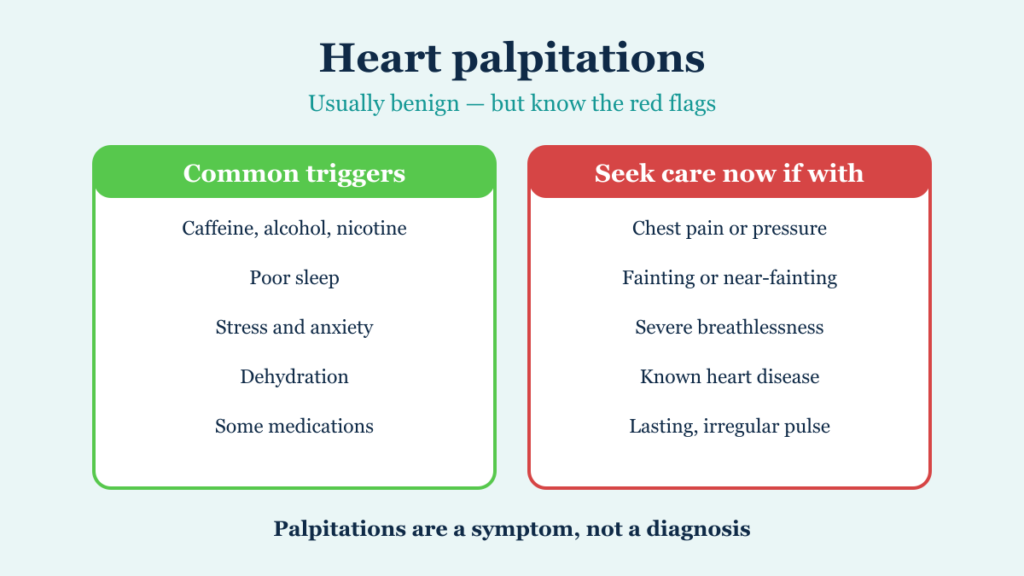
Caffeine, alcohol and nicotine. The usual suspects, and often the whole answer. Alcohol is particularly worth watching: heavy drinking is a well-recognized trigger for irregular rhythms.
Poor or short sleep. Sleep deprivation raises sympathetic nervous system activity, and palpitations frequently cluster after bad nights. If yours arrived alongside a period of poor sleep, start there — see the tiredness checklist.
Stress and anxiety. Adrenaline makes the heart beat harder and faster, and noticing it makes you more anxious, which produces more adrenaline. That loop is genuinely self-sustaining and is one of the most common patterns in people who present with palpitations.
Medications and stimulants. Decongestants containing pseudoephedrine, some asthma inhalers, thyroid replacement, ADHD medications, and many pre-workout and energy products all raise heart rate or excitability.
Dehydration and electrolytes. Low potassium or magnesium can provoke ectopic beats, as can significant fluid loss from illness, heat or intense exercise.
Hormonal shifts. Palpitations are common in pregnancy, around the menstrual cycle, and during perimenopause — a fact many women are never told, and which causes a lot of unnecessary alarm.
The medical causes worth ruling out
Several ordinary, testable conditions produce palpitations, and they are the reason a blood panel is usually the first step.
An overactive thyroid speeds the heart and often comes with weight loss, tremor, heat intolerance and anxiety. Anemia forces the heart to work harder to deliver oxygen, and is easy to miss, particularly in menstruating women. Low blood sugar triggers an adrenaline response — relevant for anyone on insulin or certain diabetes medications. Fever and infection raise heart rate directly.
A basic workup covers most of this: a complete blood count, thyroid function, electrolytes, and glucose, plus an ECG.
Atrial fibrillation deserves its own paragraph
Atrial fibrillation is the most important rhythm disturbance to identify, because it meaningfully raises the risk of stroke and is very treatable once known.
The distinguishing feature is irregularity. Benign ectopic beats interrupt an otherwise steady rhythm. In AFib the pulse is irregularly irregular — no discernible pattern at all — and often fast. Episodes may last minutes or hours and may come with breathlessness or fatigue. Crucially, AFib is sometimes entirely silent, which is part of why it goes undetected.
Learning to take your own pulse is genuinely useful here. So are consumer smartwatches with ECG features, which have become a common route to detection — they are not diagnostic on their own, but a watch alert suggesting AFib is worth taking to a doctor rather than dismissing. Background on interpreting rate in your resting heart rate.
When to seek care urgently
Call emergency services or go to an emergency department if palpitations come with chest pain or pressure, fainting or near-fainting, severe shortness of breath, or confusion. These combinations are what change palpitations from a nuisance into an emergency.
Arrange a prompt appointment if the palpitations are frequent or prolonged, if your pulse is irregular during episodes, if you have known heart disease or a history of heart attack, if there is a family history of sudden cardiac death or inherited heart conditions, or if episodes are triggered reliably by exertion. Exercise-induced palpitations deserve more attention than the resting kind.
What the tests look like
An ECG captures your rhythm at that moment, which is useful only if the palpitations happen to occur during it. Because they usually do not, the more informative test is an ambulatory monitor — a Holter worn for 24 to 48 hours, or a patch or event recorder worn for days to weeks. The aim is to catch a symptomatic episode and see what the heart was doing at exactly that moment.
Keeping a simple log while you wear it — time, what you were doing, what you had consumed — makes the recording far more useful than the recording alone.
What actually helps
For benign palpitations, the interventions are unglamorous and effective. Reduce caffeine and alcohol for two weeks and see what changes — this alone resolves a large share of cases. Protect sleep and keep a consistent schedule. Stay hydrated, particularly around exercise. Address the anxiety loop directly; slow breathing has direct measurable effects on the cardiovascular system (the science), and so does brief structured breathwork.
One honest note on supplements: magnesium is widely promoted for palpitations, and it genuinely helps if you are deficient. If you are not, the evidence that it does much is thin — our read is in what the evidence supports.
The honest bottom line
Most palpitations are extra beats in a normal heart, provoked by caffeine, alcohol, poor sleep, stress or dehydration, and they respond to removing the provocation. But palpitations are a symptom rather than a diagnosis, and a handful of causes — atrial fibrillation, thyroid disease, anemia, structural heart problems — are worth excluding with a simple blood panel and an ECG. The combinations that warrant urgent care are specific and worth memorizing: chest pain, fainting, or severe breathlessness alongside the palpitations.
Frequently asked questions
Are heart palpitations dangerous?
Usually not. Most are extra beats in a structurally normal heart, triggered by caffeine, alcohol, poor sleep or stress. They become urgent when accompanied by chest pain, fainting or near-fainting, or severe shortness of breath.
Why do I get heart palpitations when lying in bed?
Partly attention and partly physiology. In a quiet room with no distractions you simply notice beats you would miss during the day, and lying on your left side brings the heart closer to the chest wall. Evening caffeine and alcohol also contribute.
When should I see a doctor about palpitations?
Promptly if they are frequent or prolonged, if your pulse is irregular during episodes, if they are triggered by exertion, or if you have known heart disease or a family history of sudden cardiac death. Immediately if they come with chest pain, fainting or severe breathlessness.